ABT. GLOBAL
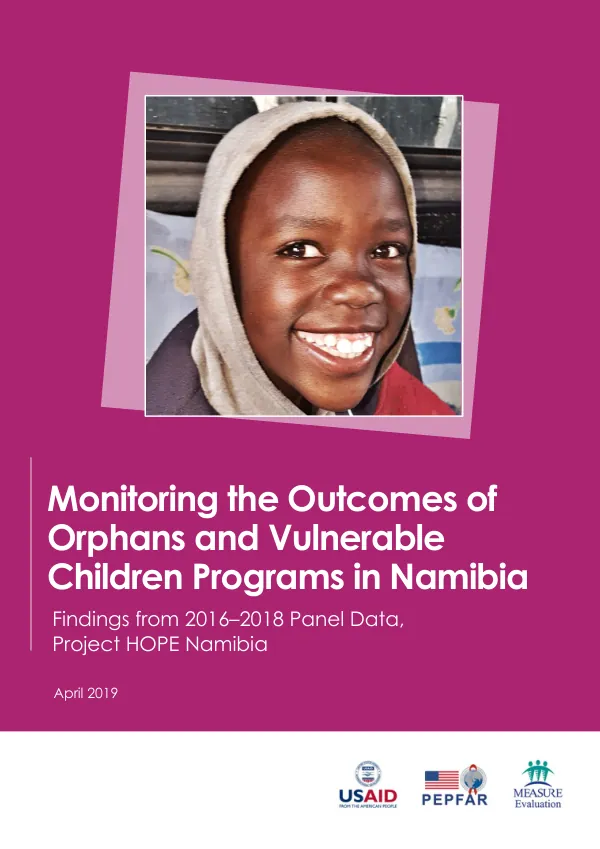
Monitoring Outcomes of PEPFAR Orphans and Vulnerable Children Programs in Namibia
The study, conducted by MEASURE Evaluation, aimed to assess the well-being of orphans and vulnerable children (OVC) in Namibia.
2019 · 1 pages
Sign in to readA free account is required to download.
Abstract
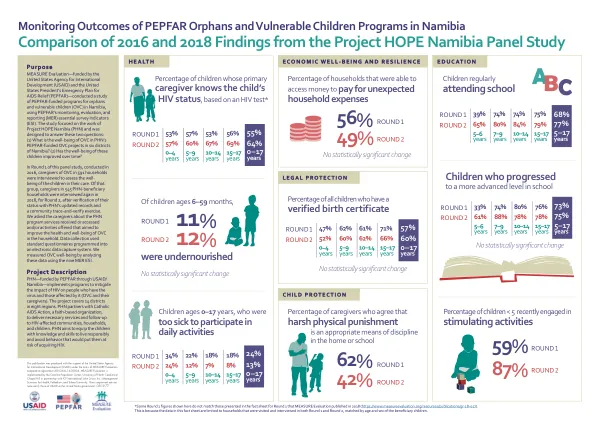
The research focused on the work of Project HOPE Namibia (PHN) and used PEPFAR's monitoring, evaluation, and reporting essential survey indicators (ESI) to analyze the impact of PHN's programs. The study collected data from caregivers in 545 PHN-beneficiary households in 2016 and again in 2018. The data showed that the percentage of children who had a birth certificate increased from 67% in 2016 to 69% in 2018. Additionally, the percentage of households that could access money for unexpected expenses rose from 53% in 2016 to 57% in 2018. However, the percentage of caregivers who believed physical punishment was an appropriate means of discipline remained high, at 62% in 2018. The study also found that the percentage of children under the age of 5 who were undernourished decreased from 42% in 2016 to 39% in 2018. Furthermore, the percentage of caregivers who knew their child's HIV status increased from 56% in 2016 to 60% in 2018. The data also showed that the percentage of children attending school increased from 71% in 2016 to 75% in 2018. The study's findings suggest that PHN's programs have had a positive impact on the well-being of OVC in Namibia. However, the data also highlight areas where further improvement is needed, such as reducing the use of physical punishment as a means of discipline. The study's results are based on data from 545 PHN-beneficiary households in 2016 and 2018. PHN implements programs to mitigate the impact of HIV on OVC and their caregivers. The organization partners with Catholic AIDS Action to deliver necessary services and follow-up to HIV-affected communities, households, and children. PHN aims to equip children with knowledge and skills to live responsibly and avoid behavior that would put them at risk of HIV. The study's methodology involved collecting data from caregivers in PHN-beneficiary households using standard questionnaires programmed into an electronic capture system. The data were analyzed to measure OVC well-being using the nine MER ESI. The study's findings suggest that PHN's programs have had a positive impact on the well-being of OVC in Namibia, but further improvement is needed in areas such as reducing the use of physical punishment as a means of discipline.