CARE
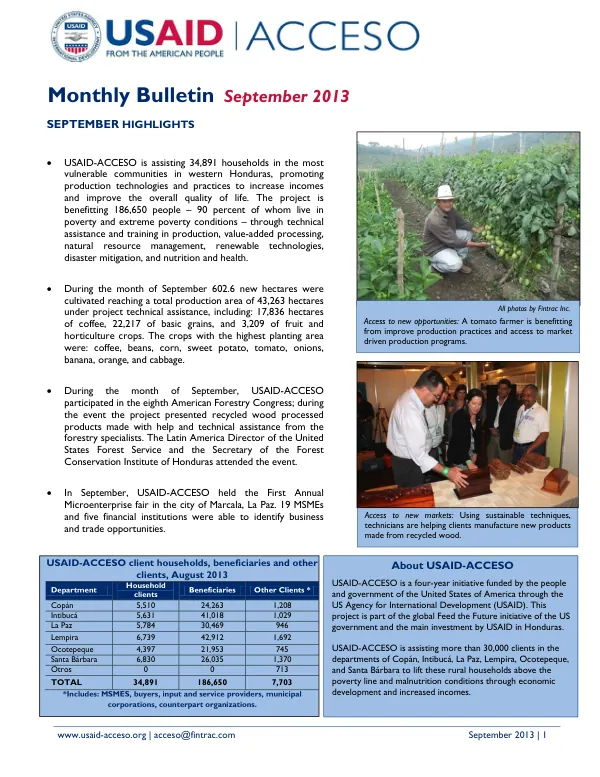
Monthly Bulletin February 2015
The USAID-ACCESO project in Honduras is a four-year initiative funded by the US Agency for International Development (USAID) to promote economic development and increase incomes for households in vulnerable communities.
2015 · 3 pages
Sign in to readA free account is required to download.
Abstract
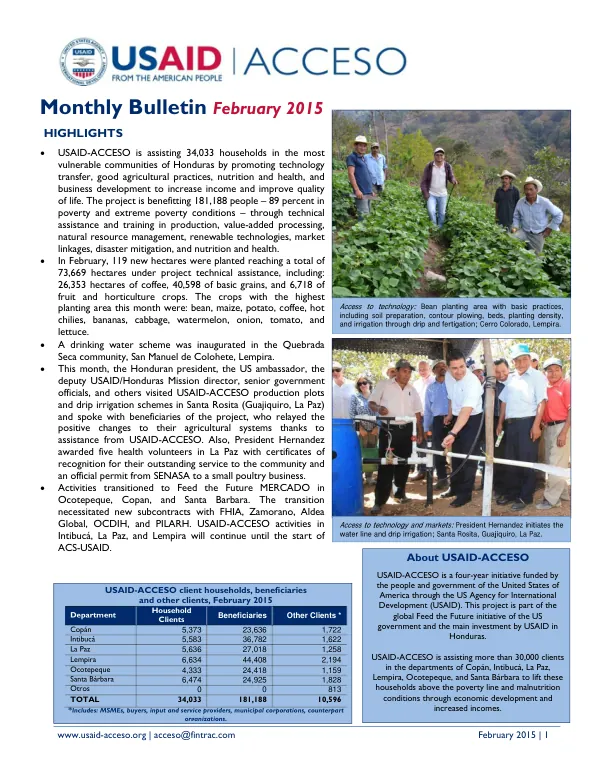
The project focuses on technology transfer, good agricultural practices, nutrition and health, and business development to lift households above the poverty line and malnutrition conditions. As of February 2015, the project is assisting 34,033 households, benefiting 181,188 people, 89 percent of whom live in poverty and extreme poverty conditions. The project's technical assistance visits reached 10,832 households this month, with 7,520 visits strengthening farmers' knowledge in agricultural production topics, including basic practices for coffee, basic grains, and horticulture crops. Additionally, 1,186 technical assistance visits focused on health and nutrition, emphasizing the importance of preventing childhood anemia through proper feeding and hygiene care. The project also provided training in animal production, natural resource management, and disaster mitigation, with 195 technical assistance visits conducted in February. USAID-ACCESO's processing specialists continued working with communities to help microenterprises perfect their processes and products to guarantee improved profitability and market success. This month, 93 participants attended 16 training events, including an event that trained eight women in San Manuel de Colohete on canned vegetables. The project also organized 76 technical assistance visits that facilitated sharing logistical details, transportation coordination, linkages with buyers, and sanitary requirements for export. The nutrition and health team held 134 training events, giving 1,628 parents the opportunity to strengthen basic nutrition and health practices. This month, 563 participants received training in the importance of closely monitoring their children's nutritional status, especially their weight, while 653 received training in family planning and optimal spacing of pregnancies. The project also provided training in nutritious food preparation and healthy household practices to establish healthy and safe norms within the home to prevent diseases and improve hygiene practices. The project's animal production specialists are providing training and technical assistance to livestock farmers to improve their animals' productivity, reduce costs, open access to new markets, and, in some cases, diversify into new income sources. In February, project specialists conducted 195 technical assistance visits focused on good livestock and poultry management, with 13 events training 80 people to improve their understanding of animal management, commercialization requirements, and fodder preparation at the community level. The project's geographic focus is on the departments of Copán, Intibucá, La Paz, Lempira, Ocotepeque, and Santa Bárbara, with a total of 34,033 households assisted as of February 2015. The project's implementation details include technical assistance visits, training events, and support for microenterprises and livestock farmers. The project's timeframes and recommendations are not explicitly stated in the provided document.