USAID DEC
Monthly Report No 42: Feed the Future Tanzania Land Tenure Assistance (LTA) May 2019
Sign inDAI GLOBAL, LLC
Monthly Report No 42: Feed the Future Tanzania Land Tenure Assistance (LTA) May 2019
The Feed the Future Tanzania Land Tenure Assistance (LTA) program is a USAID-funded initiative aimed at improving land tenure security for smallholder farmers in Tanzania.
2019 · 51 pages
Sign in to readA free account is required to download.
Abstract
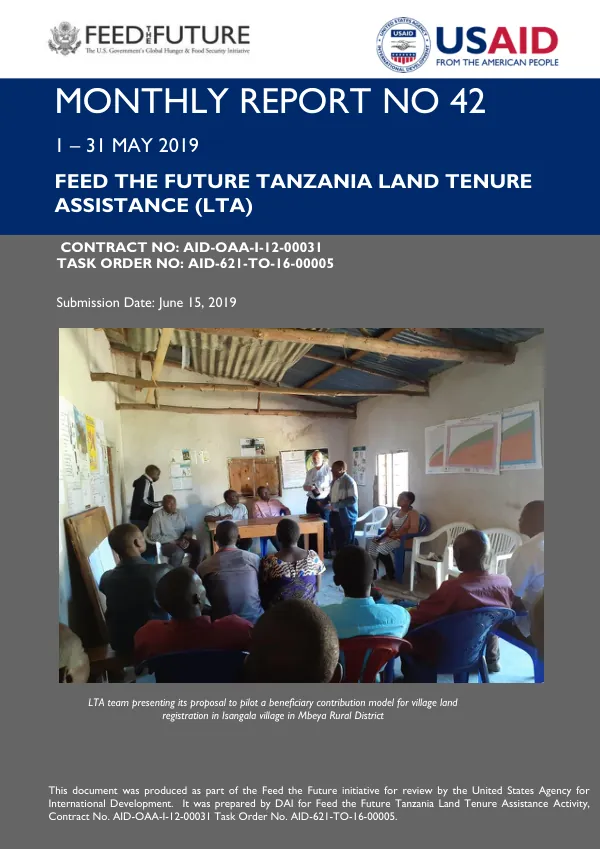
The program focuses on enhancing the capacity of local governments and communities to manage land effectively, with a particular emphasis on women's and youth's participation. In May 2019, the LTA team conducted a series of activities in the Mbeya and Iringa regions, with a focus on village land registration, boundary rectification, and dispute resolution. The team worked closely with local stakeholders, including regional and district land officials, village representatives, and residents. A total of 15 villages in the Mbeya region and 20 villages in the Iringa region were targeted for land registration and boundary rectification activities. The LTA team also implemented a beneficiary contribution model for village land registration in Isangala village, Mbeya Rural District. This model aimed to encourage community participation and ownership in the land registration process. The team provided training to village leaders and residents on the importance of land registration and the benefits of secure land tenure. In terms of implementation challenges, the LTA team faced difficulties in accessing some villages due to remote locations and lack of infrastructure. Additionally, some community members expressed concerns about the costs associated with land registration and the potential impact on their livelihoods. The team worked to address these concerns through community engagement and education. The LTA program also prioritized the integration of cross-cutting issues, including women's and youth's participation, pastoralists' needs, and USAID's forward priorities. The team conducted training sessions and workshops to promote women's and youth's participation in land management and decision-making processes. The program also worked to address the needs of pastoralists, who often face challenges in accessing land and resources. In terms of monitoring and evaluation, the LTA team tracked progress against key performance indicators, including the number of villages registered, the number of land certificates issued, and the number of disputes resolved. The team also conducted regular assessments of the program's impact on women's and youth's participation, as well as the overall effectiveness of the land registration process. The LTA program's activities in May 2019 were focused on implementing the beneficiary contribution model for village land registration, conducting land registration and boundary rectification activities, and promoting women's and youth's participation in land management. The program's progress was tracked through regular assessments and monitoring, and the team worked to address implementation challenges and concerns raised by community members.