USAID DEC
Multi-Stakeholder Co-Design Work Planning Workshop Summary
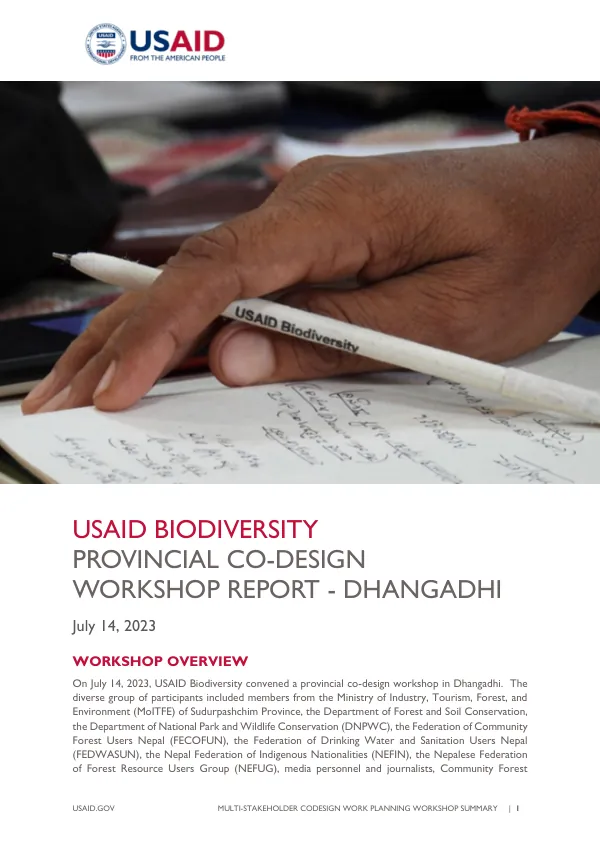
The provincial co-design workshop in Dhangadhi, convened by USAID Biodiversity, brought together a diverse group of participants from various sectors, including government, civil society, and private organizations.
2023 · 27 pages
Sign in to readA free account is required to download.
Abstract
The workshop aimed to identify threats to biodiversity and drivers of biodiversity loss, while seeking local solutions. The specific objectives of the workshop were to introduce USAID Biodiversity to provincial stakeholders, foster cooperation and mutual ownership of the activity's approach and implementation, map out threats to biodiversity, and prepare an integrated landscape-level work plan for Year 2. The workshop achieved several process objectives, including identifying dynamic partners across sectors, learning from partners who wished to participate and contribute to achieving USAID Biodiversity goals and objectives, and incorporating marginalized stakeholders into the decision-making process. The workshop also brought together different stakeholders from across multiple sectors to share different perspectives and approaches to achieving common goals and growing their own networks. USAID Biodiversity is a 5-year initiative that builds on past successes in Nepal's forestry and freshwater sectors to empower the next generation of environmental practitioners, strengthen provincial and municipal government, and catalyze new resources for climate adaptation. The initiative has three objectives: Improve Health of Ecosystems Improved in targeted Landscapes, Strengthen Environmental Crime Control and Natural Resource Safeguards, and Enhance Climate Resilience of Natural and Human Systems. The co-design component of the workshop involved participants forming five groups, each guided by a dedicated facilitator, to address specific Solution Areas. The groups brainstormed to develop ideas and further discussed to find solutions. The culmination of the group's collaborative efforts was presented to the plenary session, and a summary of recommendations and ideas was shared. One of the Solution Areas discussed was Strengthen Natural Resource Governance Capacity at Municipal and Provincial Levels. Participants addressed the question of the present status of natural resource governance capacity at municipal and provincial levels, the problems and challenges, and possible solutions. The thematic priorities included reviewing, updating, harmonizing, and drafting policies, regulations, and plans at local, municipal, and provincial levels. The present status of natural resource governance capacity at municipal and provincial levels was identified as lacking proper climate change and biodiversity policy, contradictions in Provincial Forest Act and Federal Forest Regulation, and no proper watershed conservation policy. Potential solutions included reviewing and updating policies, regulations, and plans, and drafting new ones. Specific initiatives included supporting local and provincial governments to formulate relevant policies/laws, and promoting private forests and agroforests at the local level. The workshop also identified the need for a province-level climate change resilience policy, and the promotion of private forests and agroforests at the local level. The Sudurpaschim Province was identified as a key area for implementation, with all local governments in the project site required to draft Buffer Zone Management Act. The approach required the preparation and implementation of relevant acts, policies, and guidelines at the province and local levels, and the engagement of elected representatives, community forest networks, local conservation leaders, local conservation NGOs, federations, local youths, and women's groups.