USAID
Municipal Services Program
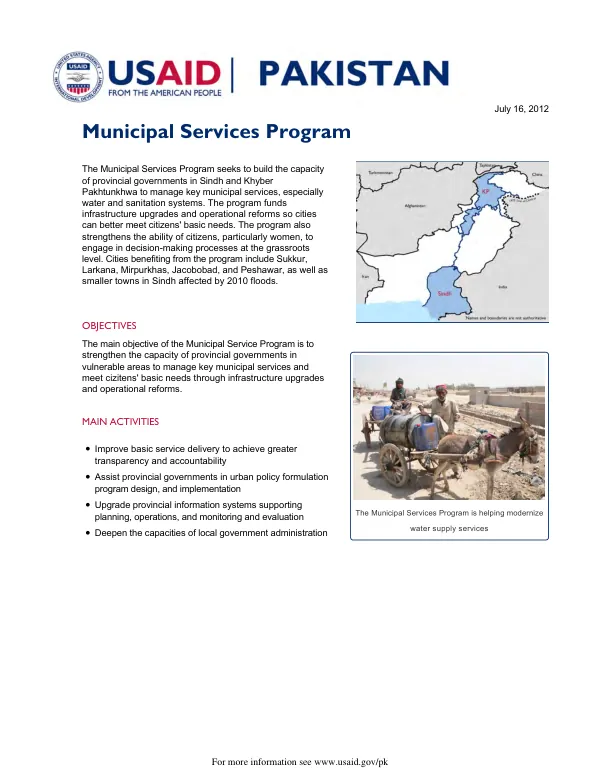
The Municipal Services Program in Pakistan aims to modernize water supply services by building the capacity of provincial governments in Sindh and Khyber Pakhtunkhwa to manage key municipal services, particularly water and sanitation systems.
2012 · 1 pages
Sign in to readA free account is required to download.
Abstract
The program funds infrastructure upgrades and operational reforms to enable cities to better meet citizens' basic needs. Additionally, it strengthens the ability of citizens, particularly women, to engage in decision-making processes at the grassroots level. Cities benefiting from the program include Sukkur, Larkana, Mirpurkhas, Jacobabad, and Peshawar, as well as smaller towns in Sindh affected by the 2010 floods. The main objective of the Municipal Services Program is to strengthen the capacity of provincial governments in vulnerable areas to manage key municipal services and meet citizens' basic needs through infrastructure upgrades and operational reforms. To achieve this objective, the program focuses on several key activities. Improving basic service delivery is a primary goal, with the aim of achieving greater transparency and accountability. Provincial governments are assisted in urban policy formulation, program design, and implementation to ensure effective management of municipal services. Upgrading provincial information systems supporting planning, operations, and monitoring and evaluation is another critical activity of the program. This involves developing and implementing information systems that enable provincial governments to make informed decisions and track the effectiveness of their programs. Furthermore, the program aims to deepen the capacities of local government administration by providing training and technical assistance to local government officials. The Municipal Services Program has a geographic focus on Sindh and Khyber Pakhtunkhwa, with a specific emphasis on vulnerable areas. The program's timeframes are not explicitly stated, but it is clear that the program is ongoing, with a focus on long-term sustainability and capacity building. The program's recommendations and implementation details are not explicitly stated, but it is likely that the program will continue to evolve and adapt to the needs of the provincial governments and citizens it serves.