SAVE THE CHILDREN FUND
Myths and Truths About Sexual Violence
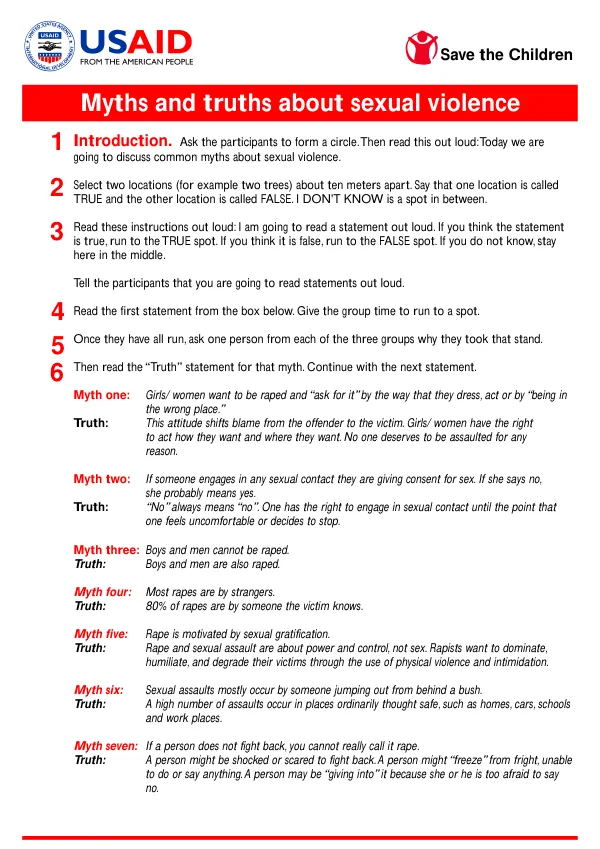
The Save the Children organization has developed a program to address common myths about sexual violence.
2 pages
Sign in to readA free account is required to download.
Abstract
The initiative involves a participatory approach, where community members are engaged in discussions to challenge and correct misconceptions about rape and sexual assault. The program begins with an icebreaker activity, where participants form a circle and are asked to stand at designated locations based on their response to a series of statements about sexual violence. The first statement presented to the group is that girls and women want to be raped and "ask for it" by the way they dress, act, or by being in the wrong place. The majority of participants respond by standing at the "FALSE" location, indicating that they do not believe this myth. The facilitator then shares the truth, stating that this attitude shifts blame from the offender to the victim and that girls and women have the right to act how they want and where they want, without fear of assault. The program continues with a series of statements, each challenging a different myth about sexual violence. The facilitator presents the following statements: if someone engages in any sexual contact, they are giving consent for sex; boys and men cannot be raped; most rapes are committed by strangers; rape is motivated by sexual gratification; sexual assaults mostly occur in isolated areas; if a person does not fight back, it cannot be called rape; if the rapist does not have a weapon, it cannot be called rape; boys and men don't usually mean to force sex on women, but sometimes they get carried away; and a lot of girls and women lead men on and then blame rape on the man. After each statement, the facilitator asks participants to share their reasons for standing at a particular location. The facilitator then shares the truth, correcting the myth and providing accurate information about sexual violence. The program highlights the importance of understanding that rape and sexual assault are not driven by passion, but by power and control. The initiative also includes a discussion component, where participants are asked to share their thoughts and experiences related to the myths presented. The facilitator asks questions such as whether people in their village believe that some of the myths are true, what statements they were surprised to learn were myths, and what they can do when they hear people repeating these myths. The program concludes with a commitment component, where participants are asked to share one thing they will do to share truths about sexual violence. The facilitator reads a statement, asking each participant to share their commitment, and the group comes together to reaffirm their commitment to challenging and correcting misconceptions about rape and sexual assault.
Related documents