USAID DEC
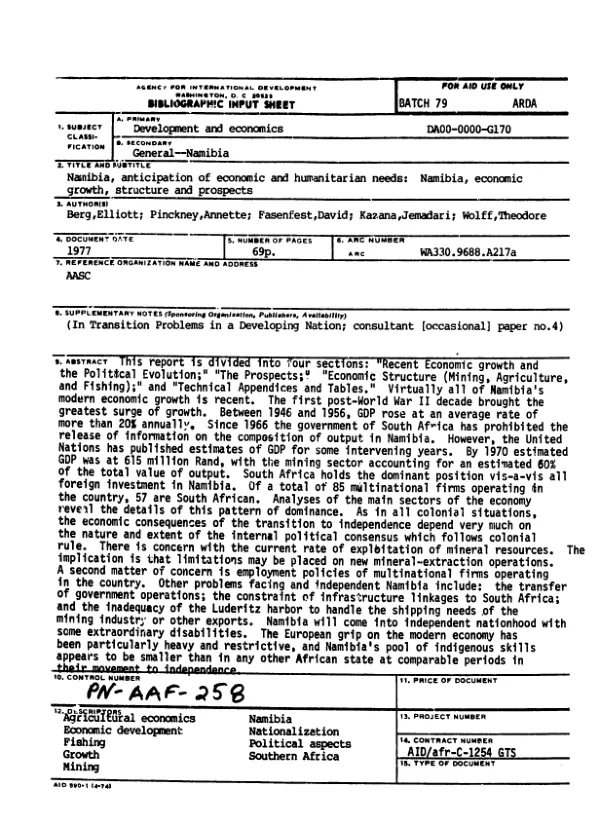
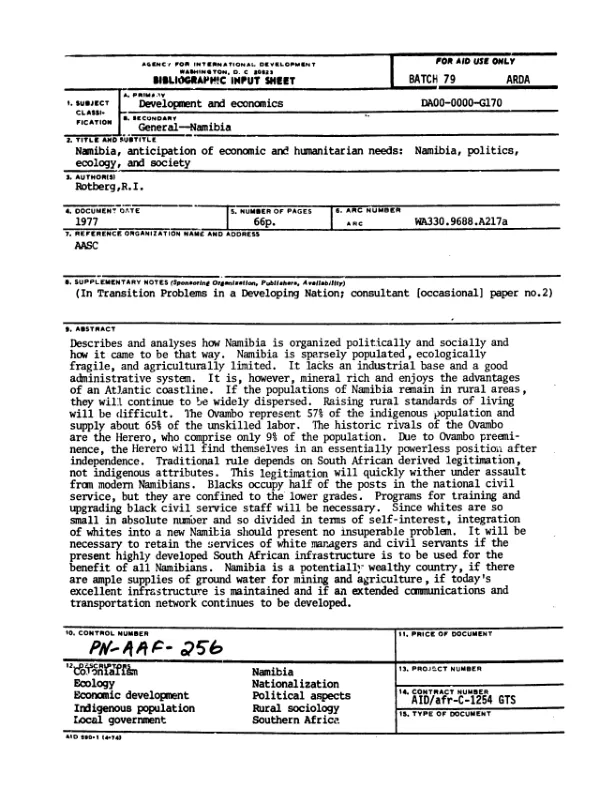
Namibia, anticipation of economic and humanitarian needs : an analysis of the main aspects of manpower and education needs for Namibia in a situation of transition
Sign inAFRICAN-AMERICAN SCHOLARS COUNCIL
Namibia, anticipation of economic and humanitarian needs : an analysis of the main aspects of manpower and education needs for Namibia in a situation of transition
The manpower problems facing Namibia in the transition to majority rule are primarily the result of colonization, the ideology of "apartheid" and "underdevelopment" as it pertains to the concept of LDC"s.
Wilks, B. S.; Anderson, James E. · 1970
Sign in to readA free account is required to download.
Abstract
All three of these phenomena have affected the development of educational processes and the resulting manpower training efforts. The present assessment of human resource requirements will also have to respond to two widely different possible situations: a negotiated settlement for Namibia as a whole, and a partitioned Namibia in which the area of concern would be the northern segment, consisting of Ovamboland, much of Damaraland and the Caprivi Strip. The agriculture, fishing, mining, transportation and communication, and government and administration sectors are analyzed separately. In the situation of a negotiated settlement for Namibia as a whole, the opportunities for U.S. technical assistance would be far greater than if guerrilla warfare continued or civil war broke out. The areas of critical high level training needs will be in central administration and policy making in agriculture, mining and resource development, communications, health, and education planning and operation. In the short-run situation, relatively large numbers of middle level skilled technicians and supervisory personnel will need to be imported, with on-the-job training programs for Namibians. If Namibia is partitioned, the U.S. will be forced to choose sides and very little programmatic involvement can be envisaged.
Related documents