USAID DEC
Zimbabwe, anticipation of economic and humanitarian needs : educational and training opportunities with Zimbabwe and in neighboring countries during and after transition
Sign inAFRICAN-AMERICAN SCHOLARS COUNCIL
Zimbabwe, anticipation of economic and humanitarian needs : educational and training opportunities with Zimbabwe and in neighboring countries during and after transition
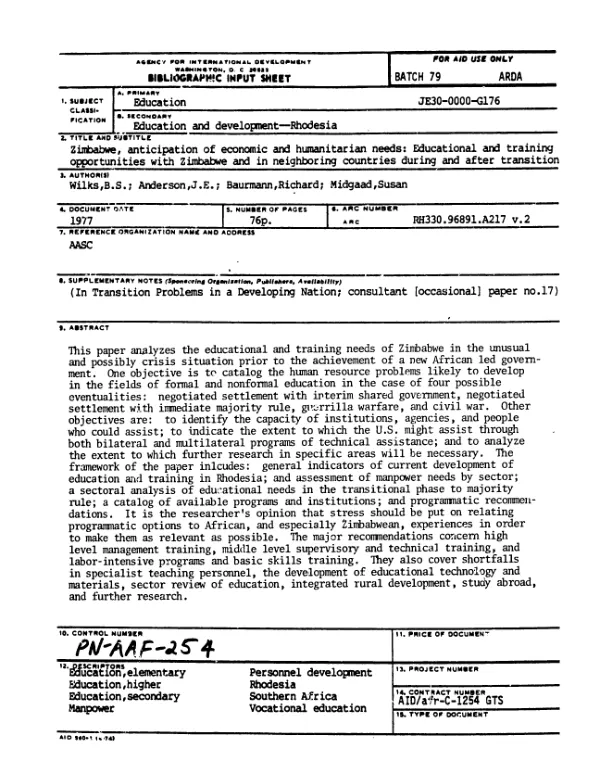
This paper analyzes the educational and training needs of Zimbabwe in the unusual and possibly crisis situation prior to the achievement of African led government.
Wilks, Brian S.; Anderson, James E. · 1970
Sign in to readA free account is required to download.
Abstract
One objective is to catalog the human resource problems likely to develop in the fields of formal and nonformal education in the case of four possible eventualities: negotiated settlement with interim shared government, negotiated settlement with immediate majority rule, guerrilla warfare, and civil war. Other objectives are: to identify the capacity of institutions, agencies, and people who could assist; to indicate the extent to which the U.S. might assist through both bilateral and multilateral programs of technical assistance; and to analyze the extent to which further research in specific areas will be necessary. The framework of the paper includes: general indicators of current development of education and training in Rhodesia; and assessment of manpower needs by sector; a sectoral analysis of educational needs in the transitional phase to majority rule; a catalog of available programs and institutions; and programmatic recommendations. It is the researcher"s opinion that stress should be put on relating programmatic options to African, and especially Zimbabwean, experiences in order to make them as relevant as possible. The major recommendations concern high level management training, middle level supervisory and technical training, and labor-intensive programs and basic skills training. They also cover shortfalls in specialist teaching personnel, the development of educational technology and materials, sector review of education, integrated rural development, study abroad, and further research.
Related documents
Documents in this collection
 1970
1970USAID DEC
Namibia, anticipation of economic and humanitarian needs : the education of refugees in Zimbabwe and Namibia
Open record 1970
1970USAID DEC