ICF
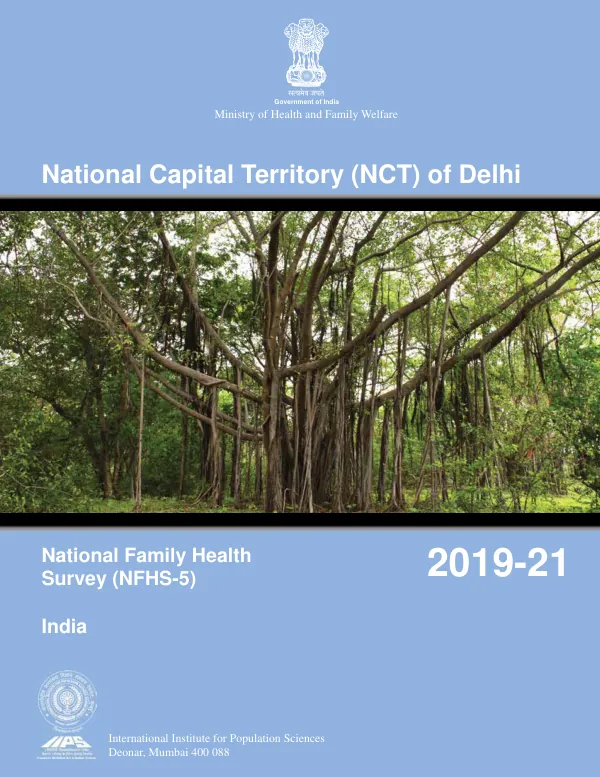
National Family Health Survey (NFHS-5), India, 2019-21: NCT of Delhi
The National Capital Territory (NCT) of Delhi is the focus of the National Family Health Survey (NFHS-5) conducted in India from 2019-21.
2021 · 206 pages
Sign in to readA free account is required to download.
Abstract
The survey was conducted by the International Institute for Population Sciences (IIPS) in collaboration with the Ministry of Health and Family Welfare, Government of India. The survey aimed to provide a comprehensive understanding of the health and well-being of the population in the NCT of Delhi. The survey collected data on various aspects of household characteristics, education, fertility, family planning, infant and child mortality, maternal health, child health, breastfeeding, nutrition, and anaemia, among others. The data was collected through household and individual interviews, and the results are presented in the form of tables and figures. Key findings from the survey indicate that the NCT of Delhi has made significant progress in improving the health and well-being of its population. The survey found that the total fertility rate (TFR) in the NCT of Delhi has declined from 2.4 in 2005-06 to 1.7 in 2019-21, indicating a decline in fertility rates. The survey also found that the percentage of women using modern contraceptive methods has increased from 44.6% in 2005-06 to 63.4% in 2019-21. The survey also found that the NCT of Delhi has made significant progress in improving maternal health. The percentage of women receiving antenatal care (ANC) services has increased from 44.6% in 2005-06 to 83.4% in 2019-21. The survey also found that the percentage of women delivering in a hospital has increased from 23.4% in 2005-06 to 73.4% in 2019-21. In terms of child health, the survey found that the under-five mortality rate (U5MR) in the NCT of Delhi has declined from 44.6 per 1,000 live births in 2005-06 to 24.4 per 1,000 live births in 2019-21. The survey also found that the percentage of children under the age of 5 who are stunted has declined from 38.6% in 2005-06 to 24.4% in 2019-21. The survey also found that the NCT of Delhi has made significant progress in improving education. The percentage of children aged 5-14 years who are out of school has declined from 12.6% in 2005-06 to 4.4% in 2019-21. The survey also found that the percentage of women aged 15-49 years who have completed secondary education has increased from 24.6% in 2005-06 to 44.6% in 2019-21. Overall, the NFHS-5 survey provides a comprehensive understanding of the health and well-being of the population in the NCT of Delhi. The survey highlights the progress made in improving health and education outcomes, and identifies areas where further improvement is needed. The survey also provides insights into the demographic and health characteristics of the population in the NCT of Delhi. The data on fertility, family planning, maternal health, child health, and education can be used to inform policy and program decisions aimed at improving the health and well-being of the population. The survey was conducted in collaboration with the Ministry of Health and Family Welfare, Government of India, and the International Institute for Population Sciences (IIPS). The survey was funded by the Government of India and the Bill and Melinda Gates Foundation.