CROWN AGENTS – USA
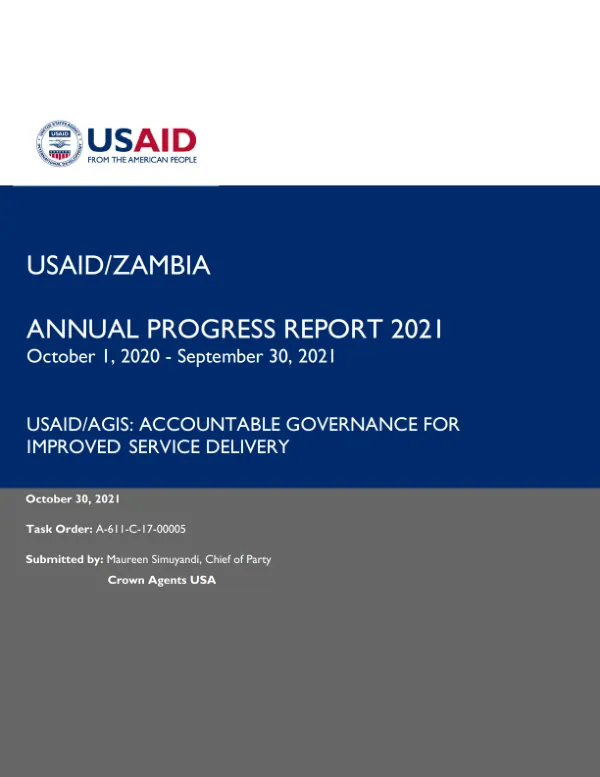
USAID/AGIS Year 4 Annual Progress Report (October 1, 2020 – September 30, 2021)
The agricultural development initiative in Zambia, implemented by USAID/AGIS, began in 2018 with the goal of improving agricultural productivity and food security in the country.
2021 · 109 pages
Sign in to readA free account is required to download.
Abstract
The project's overall objective is to increase agricultural productivity and income for smallholder farmers, with a focus on women and youth. The project's specific objectives include improving agricultural extension services, enhancing market access, and promoting sustainable agricultural practices. Implementation of the project's activities has been ongoing since October 1, 2020. Central-level activities have included the development of a district capacity development plan, which aims to strengthen the capacity of district-level institutions to deliver agricultural services. Subnational activities have focused on supporting the implementation of the district capacity development plan, with a particular emphasis on improving agricultural extension services and enhancing market access for smallholder farmers. Monitoring, evaluation, and learning activities have been an integral part of the project, with a focus on tracking progress toward the project's objectives and identifying areas for improvement. The project's activity monitoring, evaluation, and learning plan (AMELP) and performance indicator reference sheets (PIRS) have been used to track progress and identify areas for improvement. Evaluation of the project's training activities has also been conducted, with a focus on assessing the effectiveness of the training in improving agricultural productivity and income for smallholder farmers. The project has made significant progress toward its objectives, with a particular emphasis on improving agricultural extension services and enhancing market access for smallholder farmers. The project's sustainability mechanisms, including the development of a district capacity development plan and the establishment of a management monitoring system, are expected to ensure the long-term sustainability of the project's outcomes. Local capacity development has also been a key focus of the project, with a particular emphasis on strengthening the capacity of district-level institutions to deliver agricultural services. The project has also made significant progress in terms of financial management, with a focus on ensuring transparency and accountability in the use of project funds. The project's financial management system has been strengthened, with a particular emphasis on improving the accuracy and reliability of financial reporting. The project's management and administrative issues have also been addressed, with a focus on ensuring that the project is managed in a transparent and accountable manner. Key lessons learned from the project include the importance of strengthening the capacity of district-level institutions to deliver agricultural services, the need to enhance market access for smallholder farmers, and the importance of promoting sustainable agricultural practices. The project's success has also been attributed to the strong partnerships that have been established with local stakeholders, including government institutions, civil society organizations, and private sector partners. The project's geographic focus has been on the districts of Zambia, with a particular emphasis on improving agricultural productivity and income for smallholder farmers in these areas. The project's timeframes have been October 1, 2020, to September 30, 2021, with a focus on achieving the project's objectives within this timeframe. Recommendations for future projects include the need to strengthen the capacity of district-level institutions to deliver agricultural services, the need to enhance market access for smallholder farmers, and the importance of promoting sustainable agricultural practices.