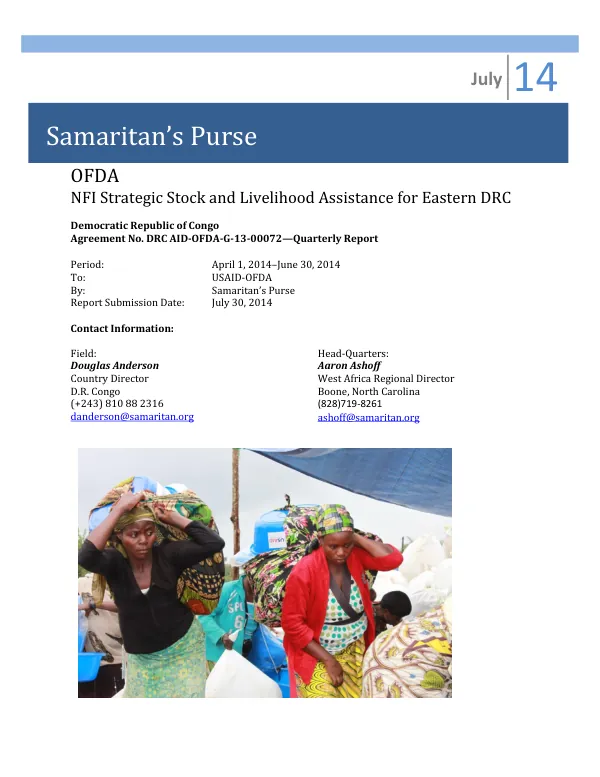
SAMARITAN'S PURSE
NFI Strategic Stock and Livelihood Assistance for Eastern DRC
The NFI Strategic Stock and Livelihood Assistance project in Eastern DRC aims to respond rapidly to the needs of conflict-affected households by increasing the effectiveness of the humanitarian response.
2014 · 5 pages
Sign in to readA free account is required to download.
Abstract
The project focuses on distributing non-food item (NFI) kits in emergency situations to help war-affected populations cope with displacement and loss. The kits include standard NFIs to assist households trying to recover from material loss. Additionally, the project seeks to improve food security by increasing and diversifying agricultural production and limited livestock distribution. Implementation of the project began in January 2014, with the goal of reaching 3,000 households (HHs) with 18,000 beneficiaries. As of March 31, 2014, Samaritan's Purse (SP) had reached 1,960 households. The project is divided into two sectors: Logistics Support and Relief Commodities, and Agriculture and Food Security. Sector 1 focuses on efficiently and rapidly responding to the needs of conflict-affected populations by strategically prepositioning NFI kits for distribution. Sector 2 aims to improve livelihood capacity through increased and diversified agricultural production. In Sector 1, the NFI team has been temporarily supporting the OCHA project, funded by the reserve mechanism, to respond to the crisis in Southern Irumu. The OCHA project allowed SP to respond to the emergency needs of 4,255 households with staff support financed by OFDA. Samaritan's Purse distributed 1,032 NFI kits through direct distribution and used the fair model to reach another 3,223 households. The remaining 1,284 kits are ready for distribution through OFDA, with plans to continue meeting emergency needs in Southern Irumu by distributing these kits in the Bwanasura region by mid-May. In Sector 2, agricultural beneficiaries are trained by SP staff monthly, including hands-on participatory training in the field. The project has developed a locally appropriate curriculum, covering topics such as transplanting, plant care, integrated pest management, and fundamental principles for good vegetable production. Goat beneficiaries have been trained on selecting quality goats, conditions for good goat reproduction, and prevention and management of internal and external parasites. Beneficiaries have completed the construction of goat shelters using local materials and environmentally sustainable methods. A total of 160 goats have been distributed, with plans to distribute the remaining goats early next quarter. Performance indicators for the project include the total number and per-item USD cost of NFIs distributed, the total number and per-item USD value of cash/vouchers distributed for NFIs, and the total number of people receiving NFIs, by sex. The project has also achieved an increase in the number of months of food self-sufficiency due to seed-system activities/agricultural inputs for beneficiary households, with a projected increase of 5 months. The number of people benefiting from seed-systems/agricultural input activities has also increased, with 18,789 people benefiting as of March 31, 2014.