USAID DEC
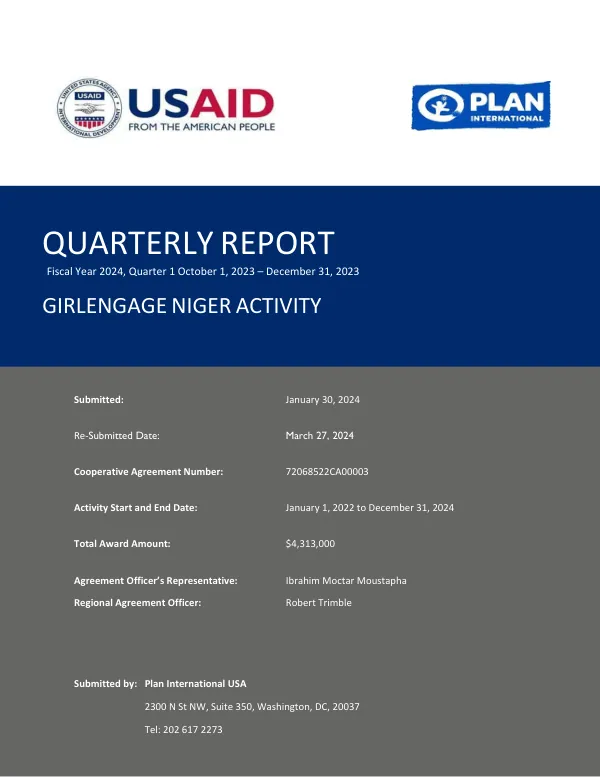
Niger Prevention of Child Early and Forced Marriage Activity Quarterly Report – FY23, Q1
Sign inPLAN INTERNATIONAL USA
Niger Prevention of Child Early and Forced Marriage Activity Quarterly Report – FY23, Q1
The Niger Prevention of Child Early and Forced Marriage Activity, implemented by Plan International USA and its partners, aims to reduce the incidence of child early and forced marriage (CEFM) in Niger, specifically in the regions of Maradi, Tillabéri, and Zinder.
2023 · 33 pages
Sign in to readA free account is required to download.
Abstract
The project, which began implementing activities in January 2022, puts girls at the center of change while also working with boys, teachers, religious and community leaders, parents of children, civil society organizations, and state structures. The project's primary objective is to value and prioritize the girl child in target communities, with a focus on increasing access to quality, safe basic education opportunities for adolescent girls. To achieve this goal, girls' steering committees, village child protection committees (CVPE), and Future Husbands Clubs (CdFM) were established in all 24 project villages in Maradi and Tillabéri. The project incorporates the principles of human-centered design and positive youth development to intentionally move girls from passive recipients to active participants at all stages of the project. Key achievements in the first quarter of FY23 include the project launch in the regions of Maradi and Tillabéri, a campaign to identify young people (aged 9-15) with no birth certificate and provide them with legal identity through a birth certificate in the 24 project intervention villages, community meetings of GirlEngage steering committees, and a monitoring mission led by the Project Director and MERL Advisor in Maradi. Additionally, the project team organized modular sessions with girls in safe spaces, provided materials and equipment for safe spaces, and distributed materials and equipment to CdFMs in the Maradi region. The project also trained religious leaders on Islamic religious messages and arguments relating to girls' education and CEFM in Tillabéri and Maradi, organized an evaluation of the educational level of girls in grades 3 and 4 in GirlEngage partner schools in Maradi and Tillabéri, and identified vulnerable girls in project schools. Furthermore, the project organized training for teachers on positive discipline and the newly revised Code of Conduct in GirlEngage partner schools in the Maradi and Tillabéri regions, and trained secondary school teachers on sexual and reproductive health in GirlEngage partner schools in Maradi and Tillabéri. The project's impact is evident in the establishment of girls' steering committees, CVPEs, and CdFMs in all 24 project villages, which has led to increased community engagement and ownership of the project's objectives. The project's focus on girls' education and empowerment has also led to increased access to quality education for adolescent girls, with a total of 400 birth certificates delivered to young people in four villages during the reporting period. The project's collaborative approach with state services, local elected officials, and civil society organizations has also ensured local support for the project's objectives. The project's progress on key indicators is outlined in Annex I, which provides a detailed breakdown of the project's achievements and impact. The financial summary is provided in Annex 2, and success stories are highlighted in Annex 3. Data from the baseline survey is also provided in Annex 4, which provides a comprehensive overview of the project's baseline conditions and indicators.