NON-GOVERNMENTAL ORGANIZATION
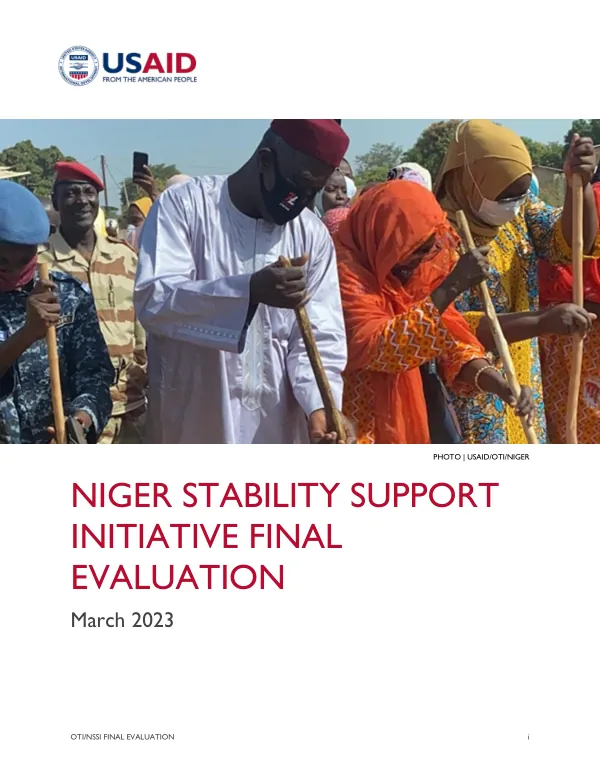
Niger Stability Support Initiative Final Evaluation
The Niger Stability Support Initiative (NSSI) was launched in September 2020 by the Office of Transition Initiatives (OTI) to support the Government of Niger's stabilization, peacebuilding, and development efforts.
2023 · 59 pages
Sign in to readA free account is required to download.
Abstract
The program focused on the southwest part of the Dosso Region, primarily along the border with Benin and Park W, where violent extremist organizations (VEOs) were increasingly active. NSSI implemented four lines of effort in Dosso: bolstering local authorities' governance, supporting traditional leaders with conflict and crisis management, strengthening the relationship between local leaders and community members, and providing support and training to forest rangers. The program aimed to strengthen government action in response to threats to stability and reinforce the links between and within government structures and communities. NSSI's activities were implemented in the Dosso Region of Niger between September 2020 and December 2023. The evaluation employed a mixed-methods approach, using key informant interviews, quantitative surveys, and desk reviews to answer the evaluation questions. NSSI's results indicate that the program has been successful in achieving its objectives. Authorities in the Dosso Region have a better understanding of the drivers of conflict and how to respond to them. Mayors and prefets are engaging more with their constituencies, conducting outreach, and sharing conflict mitigation strategies. Communities report that authorities are more engaged and effective in conflict management and mitigation. The National Mediated Office has become more proactive and has successfully advocated for funding to launch its own initiatives focused on strengthening social cohesion. Corruption has decreased, and the relationship between transporters and authorities has improved. Transporters report that corruption among border agents has been eliminated, and communities are playing an increasingly active role against trafficking. Authorities are intercepting more trafficked goods, and the number of seizures has increased each year since NSSI programming began. Authorities are willing to scale successful models of engagement to other areas, provided with concrete recommendations and training materials. Conflicts have reduced in NSSI's key areas of operation, with deaths from land conflicts dropping to zero for the first time in over ten years. Community members have improved skills in conflict management and conflict management and response. Ninety-eight percent of community members surveyed reported an improved understanding of how to manage conflict and respond to crises, and 92 percent confirmed they were able to put this knowledge into practice. Training traditional leaders on the rural code has significantly increased their involvement in the successful mediation of conflict. Youth fadas, or neighborhood youth associations, are important for information transmission. Ensuring all youth fadas sent representatives to youth activities helped increase participation and facilitated the rapid spread of information after NSSI completed its activities. The program has also led to notable and sustained improvement in relationships between authorities and targeted youth, with youth fadas playing a key role in this process. The evaluation found that NSSI's activities have had a positive impact on the stability and peacebuilding efforts in the Dosso Region. The program's results demonstrate that its interventions have been effective in strengthening government action, reinforcing links between and within government structures and communities, and improving relationships between authorities and community members.