WORLD HEALTH ORGANIZATION
Nigeria HPN Multi-Activity Evaluation: Ebonyi State
The Nigeria HPN Multi-Activity Evaluation in Ebonyi State was conducted by Data for Impact (D4I) in collaboration with Data Research and Mapping Consult Ltd.
2023 · 9 pages
Sign in to readA free account is required to download.
Abstract
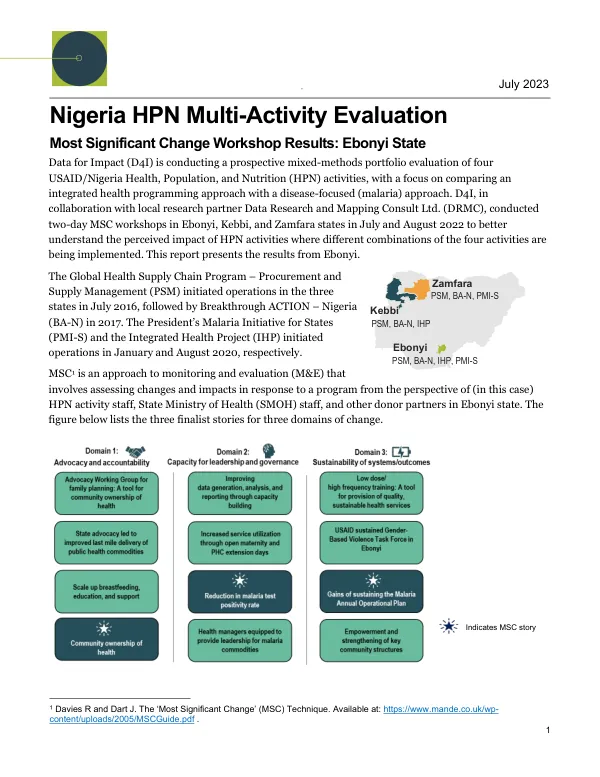
(DRMC) to assess the perceived impact of USAID/Nigeria Health, Population, and Nutrition (HPN) activities. The evaluation focused on comparing an integrated health programming approach with a disease-focused (malaria) approach. The study involved a prospective mixed-methods portfolio evaluation of four HPN activities: the Global Health Supply Chain Program – Procurement and Supply Management (PSM), Breakthrough ACTION – Nigeria (BA-N), the President’s Malaria Initiative for States (PMI-S), and the Integrated Health Project (IHP). The evaluation used the Most Significant Change (MSC) technique, which involves assessing changes and impacts in response to a program from the perspective of HPN activity staff, State Ministry of Health (SMOH) staff, and other donor partners in Ebonyi state. The MSC workshop in Ebonyi state was attended by 16 participants, including representatives from HPN activities, SMOH, and the World Health Organization (WHO). The participants shared stories of change related to three domains: advocacy and accountability for health, capacity for leadership and governance in healthcare, and sustainability of health systems and health outcomes. The participants narrowed down the stories they considered significant and ultimately identified one story per domain as "most significant." The people who benefited from the interventions described in the stories were primarily women of reproductive age, pregnant women, mothers, children, people with malaria, and survivors of gender-based violence. The evaluation identified several significant changes in Ebonyi state, including the creation of a state budget specifically for family planning, improved last mile delivery of public health commodities, and increased breastfeeding rates. The evaluation also highlighted the importance of community ownership of health, with BA-N working with existing community structures to put the responsibility of health in people's own hands. The Most Significant Change stories identified in the evaluation included: * Group 1: Advocacy Working Group for family planning, which led to the creation of a state budget specifically for family planning and increased perceived visibility and uptake of family planning services. * Group 2: State advocacy led to improved last mile delivery of public health commodities, which reduced delays and loss of commodities to theft. * Group 3: Scale up breastfeeding, education, and support, which changed people's perspective on breastfeeding and increased the level of breastfeeding. * Group 4: Community ownership of health, which empowered community members to take ownership of their own health and promoted healthy behaviors such as antenatal care attendance, IPTp, and exclusive breastfeeding. The evaluation highlighted several lessons learned, including the importance of a standing committee for advocacy and accountability, the need for involvement of SMOH and local government staff in last mile delivery, and the effectiveness of community ownership of health in promoting healthy behaviors.
Related documents