USAID FAMINE EARLY WARNING SYSTEMS NETWORK
NIGERIA Market Assessment Summary
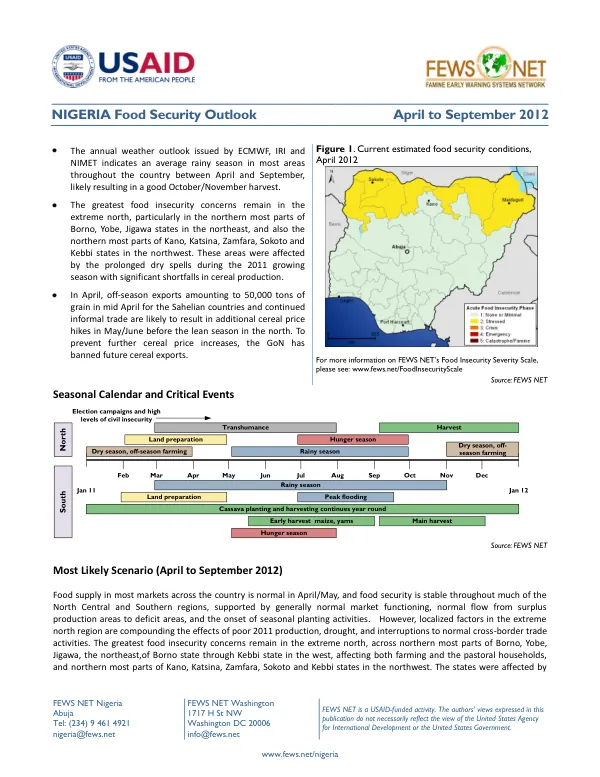
Nigeria's food security conditions are characterized by localized food insecurity in the extreme north due to civil insecurity.
2012 · 6 pages
Sign in to readA free account is required to download.
Abstract
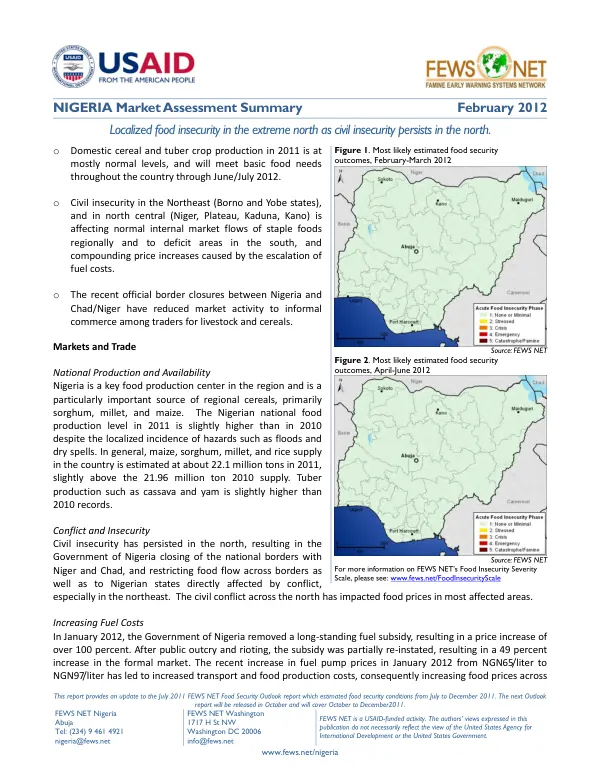
Domestic cereal and tuber crop production in 2011 is at mostly normal levels, meeting basic food needs throughout the country through June/July 2012. However, civil insecurity in the Northeast and north central regions is affecting normal internal market flows of staple foods regionally and to deficit areas in the south, compounding price increases caused by the escalation of fuel costs. The recent official border closures between Nigeria and Chad/Niger have reduced market activity to informal commerce among traders for livestock and cereals. Nigeria is a key food production center in the region and is a particularly important source of regional cereals, primarily sorghum, millet, and maize. The Nigerian national food production level in 2011 is slightly higher than in 2010, despite the localized incidence of hazards such as floods and dry spells. In general, maize, sorghum, millet, and rice supply in the country is estimated at about 22.1 million tons in 2011, slightly above the 21.96 million ton 2010 supply. Tuber production such as cassava and yam is slightly higher than 2010 records. Civil insecurity has persisted in the north, resulting in the Government of Nigeria closing of the national borders with Niger and Chad, and restricting food flow across borders as well as to Nigerian states directly affected by conflict, especially in the northeast. The civil conflict across the north has impacted food prices in most affected areas. In January 2012, the Government of Nigeria removed a long-standing fuel subsidy, resulting in a price increase of over 100 percent. After public outcry and rioting, the subsidy was partially re-instated, resulting in a 49 percent increase in the formal market. The recent increase in fuel pump prices in January 2012 from NGN65/liter to NGN97/liter has led to increased transport and food production costs, consequently increasing food prices across the country. Despite fuel prices increase, fuel is scarce country-wide and most fuel is purchased at unofficial rates. This is particularly the case in rural areas in the extreme north, given the distance from fuel depots in the south, which causes delivery delays that are also exacerbated by civil conflict and bad road conditions. The impact of rising fuel prices on food prices is less significant in the north central areas as most poor households depend on their own production for annual food stocks. Poor households in the area will be impacted during the lean season when they resort to market purchase, as food prices typically increase. Another anticipated official increase in fuel pump prices in April, coupled with trader speculation will likely increase food prices in most markets across the country. Food flow to the southern deficit areas and to production deficit areas in the extreme north may be impacted significantly, restricting food access for poorer households. In order to cope with food price hikes, affected poor households will intensify engagement in casual labor, the sale of small ruminants such as goats and sheep, charcoal hawking, and taking on new debt to meet their basic food needs. Nigerian food commodity markets are highly integrated both domestically and regionally, enabling a smooth flow of food commodities from surplus to deficit zones across borders with Niger and Chad, and within the central and eastern market basins. Nigerian cereal exports account for a significant portion of national cereal supply in several countries, including Niger, Chad, and Mali. Industries such as malting companies, food processors, and poultry farmers typically buy cereals such as sorghum, millet, and maize as raw materials. However, industrial demand is relatively low as of January 2012 according to traders associations in the northwest, in Zamfara, Sokoto, and Katsina states, likely due to limited access to bank loans and high cost of production due to increased fuel price. Markets are well integrated across the country and food commodities (cowpea, maize, millet, sorghum) are flowing normally from the surplus production zones in the north to the deficit areas in the south. Food flow from the north central to the extreme north is very good, especially for maize and sorghum, offsetting localized food deficits in Zamfara, Sokoto, Katsina, and Jigawa states.
Related documents