DELOITTE CONSULTING, LLP
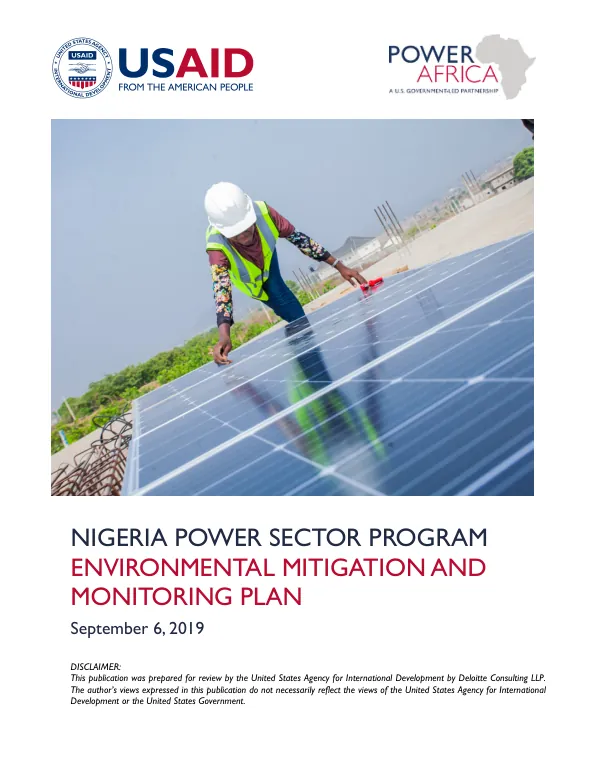
Nigeria Power Sector Program Environmental Mitigation and Monitoring Plan
The Nigeria Power Sector Program (NPSP) is a comprehensive initiative launched by Power Africa in April 2018 to address the challenges facing Nigeria's power sector.
2019 · 79 pages
Sign in to readA free account is required to download.
Abstract
The program aims to increase electricity availability, access, and reliability throughout Nigeria, while measuring objective progress across various thematic technical areas. These areas include gas, transmission, distribution, and renewable energy. The power sector in Nigeria faces significant challenges, including distribution companies' inability to make necessary capital investments in network improvement and infrastructure. The Transmission Company of Nigeria's planned expansion of grid capacity from 7,000 MW to 20,000 MW by 2020 requires an estimated $8 billion in investment. The power sector regulator also faces challenges in regulating an evolving market structure that has experienced both unbundling and rapid privatization in the same decade. To address these challenges, NPSP employs a flexible approach to develop, deploy, evaluate, and sustain various interventions and activities responding to Nigeria's critical needs and broader economic, political, and social developments of the power sector. The program will increase electricity availability, access, and reliability throughout Nigeria, while measuring objective progress across the thematic technical areas. NPSP's scope includes comprehensive power sector reform, a strengthened enabling environment, and increased private sector investment. The program will support the development of a robust and sustainable power sector in Nigeria, with a focus on improving the country's access to affordable, reliable power. The program's implementation will be carried out over a period of five years, from April 2018 to April 2023. The Environmental Mitigation and Monitoring Plan (EMMP) is a critical component of NPSP, which aims to minimize the environmental impacts of the program's activities. The EMMP outlines the procedures for environmental mitigation and monitoring, including the identification of potential environmental impacts, development of mitigation measures, and implementation of monitoring and reporting procedures. The EMMP is based on the Environmental Review Form and Report (ERF/ERR) developed by USAID/Africa, which provides a framework for environmental review and reporting. The EMMP also incorporates the Environmental and Social Review Methodology (PESRM) developed by the Power Africa Transaction and Reform Program (PATRP), which provides a framework for environmental and social review of transactions. The EMMP outlines the roles and responsibilities of various stakeholders, including the implementing partner, Deloitte Consulting LLP, and the USAID/Nigeria EGE Office. The plan also outlines the procedures for environmental monitoring and reporting, including the use of the Qualified Transactions Assistance Tool (QTAT) and the Environmental Review Checklist (ERC). The EMMP is an essential component of NPSP, which aims to ensure that the program's activities are carried out in an environmentally responsible manner. The plan will help to minimize the environmental impacts of the program's activities and ensure that the program's objectives are achieved in a sustainable and environmentally responsible manner.