USAID DEC
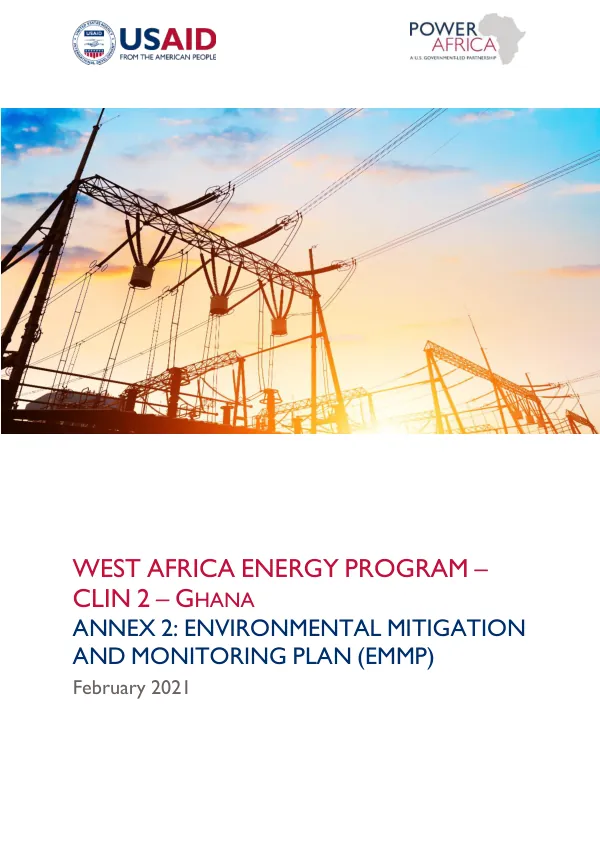
Environmental Mitigation and Monitoring Plan (EMMP) for the USAID West Africa Energy Program (WAEP) - CLIN 2 - Ghana
Sign inDELOITTE CONSULTING, LLP
Environmental Mitigation and Monitoring Plan (EMMP) for the USAID West Africa Energy Program (WAEP) - CLIN 2 - Ghana
The USAID-funded Power Africa West Africa Energy Program (WAEP) is a comprehensive initiative aimed at expanding the supply of and access to affordable and reliable grid-connected electricity services in West Africa.
2021 · 65 pages
Sign in to readA free account is required to download.
Abstract
The program, implemented by Deloitte Consulting LLP, seeks to advance development priorities including inclusive economic growth, security, and improved health and education outcomes. The ultimate goal of the program is to increase access to electricity, which is essential for economic growth and development. The program comprises two components, with the Ghana component (CLIN 002) focusing on achieving three key outcomes: Optimized Supply of Power, Access to Affordable and Reliable Grid-Based Power Increased, and Performance of National Utilities and Power Sector Entities Improved. The program's activities in Ghana are reflected in a separately submitted Work Plan and its associated Annexes. The program's environmental compliance approach is guided by the Power Africa 2 Project Appraisal Document (PAD) Initial Environmental Examination (PIEE) approved in September 2016. In November 2020, USAID completed and approved its environmental determination for the Program, determining that it is in line with the Power Africa 2 PAD IEE and does not pose any significant threats to human health and the environment. However, some types of activities have been assigned a "Negative Determination with Conditions (NDWC)". The WAEP Task Order contract requires that an Environmental Mitigation and Monitoring Plan (EMMP) be prepared and submitted when USAID's IEE determines that certain activities lead to a NDWC. The EMMP must document how the Program's proposed activities and interventions will comply with Section 117 of the Foreign Assistance Act of 1961, as amended, which requires the consideration of the impacts of USAID-funded activities, including environmental sustainability impacts as well as USAID environmental requirements under 22 Code of Federal Regulations (CFR) Part 216. The EMMP submitted by the Program reflects the updated November 2020 Initial Environmental Examination Report and outlines the program's environmental mitigation and monitoring procedures. The plan documents how the program's proposed activities and interventions will comply with environmental requirements and minimize potential environmental impacts. The program's environmental review for outcome-based activities is outlined in Figure 1, which illustrates the program's environmental review process. The program's potential environmental impacts and mitigation responses are also outlined in the EMMP, which includes a climate risk management matrix for Ghana program outcomes. The EMMP is a critical component of the program's environmental compliance approach, and it will be reviewed and approved by the USAID TOCOR and the Power Africa Environmental Officer (PAEO). The program's environmental mitigation and monitoring procedures will be implemented to ensure that the program's activities are carried out in an environmentally responsible manner and that potential environmental impacts are minimized. The program's activities in Ghana will be implemented in accordance with the program's Work Plan and its associated Annexes, which outline the program's objectives, activities, and timelines. The program's environmental compliance approach will be guided by the EMMP, which will be reviewed and updated as necessary to ensure that the program's activities are carried out in an environmentally responsible manner. The program's implementation start date is 2019, and the program's activities will be carried out over a period of several years. The program's geographic location is Ghana, and the program's implementing partner is Deloitte Consulting LLP. The program's tracking ID is 720-674-19F-00008, and the program's related IEE tracking IDs are 42571 and 47036.
Related documents