MANAGEMENT SYSTEMS INTERNATIONAL
Fragility and Climate Risks in Nigeria
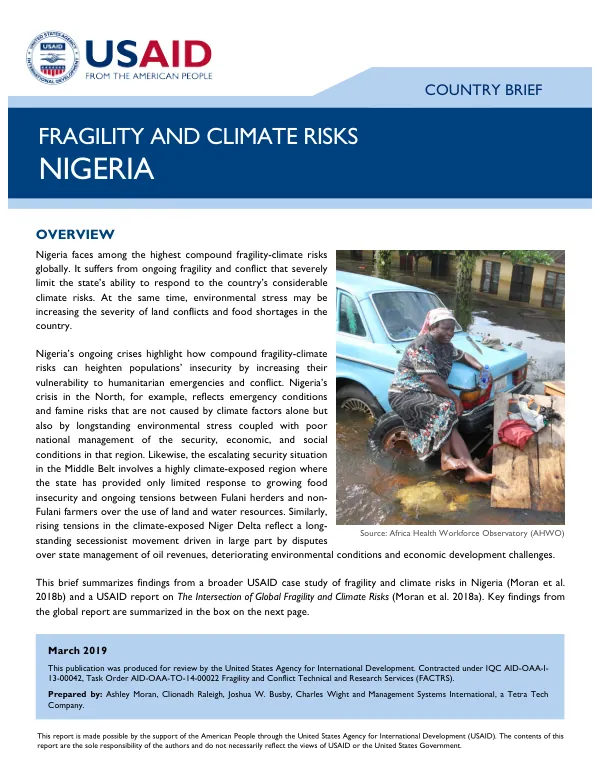
Nigeria faces among the highest compound fragility-climate risks globally.
2019 · 10 pages
Sign in to readA free account is required to download.
Abstract
The country suffers from ongoing fragility and conflict that severely limit the state's ability to respond to its considerable climate risks. Environmental stress may be increasing the severity of land conflicts and food shortages in Nigeria. Fragility is an important dimension in understanding the indirect pathways between climate risks and potential conflict outcomes. State-society relations and the dynamics of legitimacy and effectiveness enhance the ability to identify and understand indirect pathways through which vulnerability is compounded and, conversely, where resilience efforts can have co-benefits for climate, environment, and conflict prevention goals. Nigeria's ongoing crises highlight how compound fragility-climate risks can heighten populations' insecurity by increasing their vulnerability to humanitarian emergencies and conflict. The country's crisis in the North reflects emergency conditions and famine risks that are not caused by climate factors alone but also by longstanding environmental stress coupled with poor national management of the security, economic, and social conditions in that region. Nigeria's fragility is characterized by poor state effectiveness and even more so from poor and dwindling state legitimacy. The country experiences the highest fragility of all countries in West Africa and among the highest fragility of all countries in sub-Saharan Africa. Fragility in Nigeria stems from poor state effectiveness, including low capacity of public sector institutions, and poor and dwindling state legitimacy, including low public support for government arrangements, officials, and practices. The country has high fragility in all four spheres of state-society interactions—political, security, economic, and social—struggling to deliver services, prevent corruption, ensure political pluralism, and maintain security. Nigeria has more than 41 million people—24 percent of its population—living in high climate exposure areas, facing diverse and extensive climate risks from storm surges, inland flooding, wildfires, decreased rainfall, droughts, and floods. While Nigeria faces extensive climate risks, the severity of fragility and conflict in the country has hindered its response to these climate challenges. Environmental stress—coupled with government mismanagement of environmental and other stressors—contributes to instability the country now faces from food crises and land conflicts, risking a dangerous feedback loop between fragility and climate risks. Nigeria must reduce fragility in all four spheres, as addressing its climate challenges will require resilience initiatives in the social and economic spheres, effective political processes to serve as a conduit between public needs and state responses, and a stable security environment in which to operate.
Related documents