CENTER FOR EDUCATIONAL DEVELOPMENT
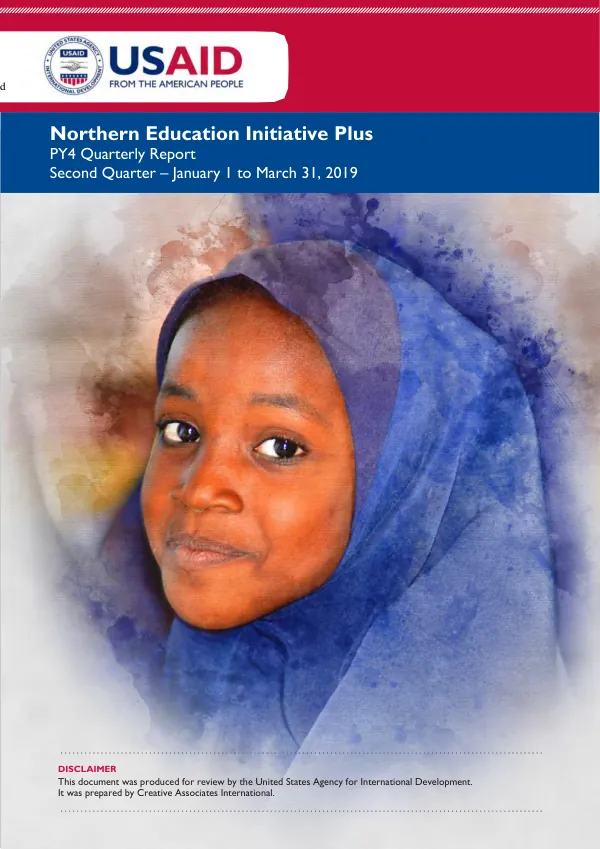
Northern Education Initiative Plus - PY4 Quarter 2 Report
The Northern Education Initiative Plus is a program aimed at improving education outcomes in Northern Nigeria.
2019 · 98 pages
Sign in to readA free account is required to download.
Abstract
The program is implemented by Creative Associates International, with a contract number of AID-620-C-15-00002, and is funded by the United States Agency for International Development. The program's geographic coverage includes Bauchi and Sokoto States, and its reporting period is from January 1 to March 31, 2019. The program's main objective is to strengthen government systems to increase the number of students enrolled in appropriate, relevant, and approved educational options, especially girls and out-of-school children in target locations. To achieve this objective, the program focuses on two intermediate results: strengthening government systems to increase the number of students enrolled in educational options, and strengthening government systems to improve reading outcomes for primary grade learners in target locations. Under the first intermediate result, the program aims to increase the number of educational options meeting school quality and safety benchmarks, strengthen systematic approaches to school management and supervision, standardize the non-formal learning center model to ensure education for vulnerable children and youth, and strengthen civil society organization capacity to mobilize parent-teacher associations, school-based management committees, and communities around reading and access. Under the second intermediate result, the program aims to improve reading outcomes for primary grade learners in target locations by improving state and local government policies, timetables, and standards for reading instruction and performance, developing and distributing decodable readers, teacher guides, and supplemental materials for early grade reading instruction, providing in-service training to teachers in public and non-formal learning center classrooms, monitoring and coaching in-service teachers, and assessing early grade reading instruction. The program's implementation status is reported in the quarterly report, which highlights progress made towards achieving the program's objectives. The report also provides information on project monitoring and evaluation, integration of cross-cutting issues and USAID forward priorities, stakeholder participation and involvement, project operations and management, and planned activities for the next quarter. In terms of implementation, the program has made significant progress in strengthening government systems to increase the number of students enrolled in educational options. For example, the program has established 15 non-formal learning centers in Bauchi and Sokoto States, which have provided education to over 2,500 out-of-school children. The program has also strengthened systematic approaches to school management and supervision, and has standardized the non-formal learning center model to ensure education for vulnerable children and youth. In addition, the program has made progress in improving reading outcomes for primary grade learners in target locations. For example, the program has developed and distributed decodable readers, teacher guides, and supplemental materials for early grade reading instruction, and has provided in-service training to teachers in public and non-formal learning center classrooms. The program has also monitored and coached in-service teachers, and has assessed early grade reading instruction. Overall, the Northern Education Initiative Plus is making significant progress in improving education outcomes in Northern Nigeria. The program's focus on strengthening government systems, improving reading outcomes, and providing education to out-of-school children is critical to achieving the program's objectives and improving education outcomes in the region.
Related documents