CREATIVE ASSOCIATES INTERNATIONAL INC.
NRTI Annual Report – FY 2015 (September 2014 – September 2015)
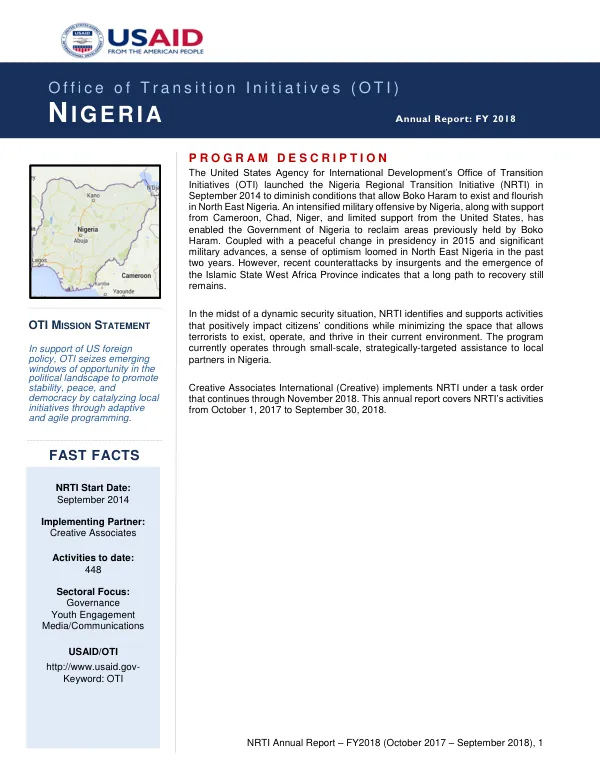
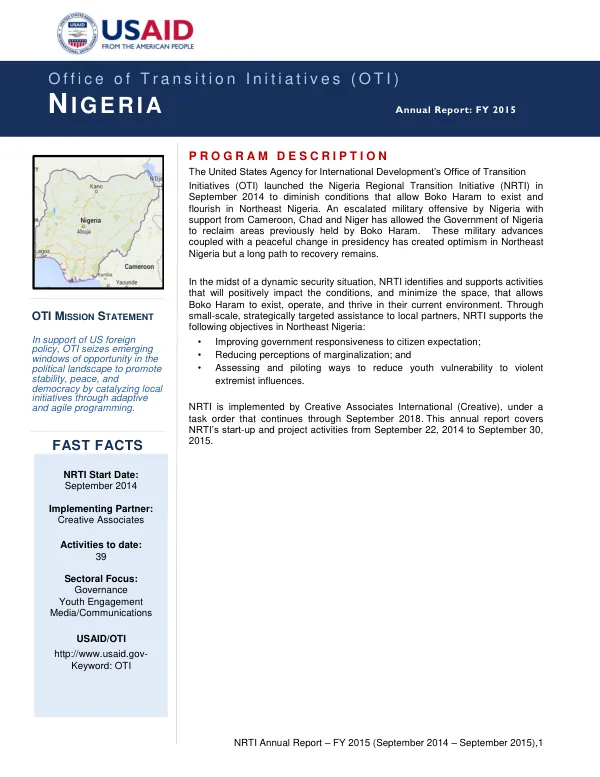
The Nigeria Regional Transition (NRT) initiative was launched in September 2014 by the United States Agency for International Development's Office of Transition Initiatives (OTI).
2015 · 10 pages
Sign in to readA free account is required to download.
Abstract
The program aimed to diminish conditions that allow Boko Haram to exist and flourish in Northeast Nigeria. An escalated military offensive by the Nigerian government, supported by Cameroon, Chad, and Niger, allowed the government to recapture areas previously held by Boko Haram. This military action, coupled with a change in presidency, created a sense of optimism in Northeast Nigeria. NRTI identified and supported activities that would positively impact the conditions allowing Boko Haram to exist, minimize their space, and thrive in their environment. The program focused on three objectives: improving government responsiveness to citizen needs, reducing perceptions of marginalization, and assessing and piloting ways to reduce youth vulnerability to violent extremist influences. Initial research conducted by Navanti Group demonstrated a high degree of perceived marginalization in the northeast, with widespread unemployment and socioeconomic marginalization cited as primary factors in the spread of violent extremism. The research also highlighted ideology as a pull factor, though less powerful than socioeconomic factors and forced conscription. Based on the research and initial pilot activities, NRTI leadership reviewed the program's objectives and made adjustments to reflect the desired outcomes. The goal shifted from overall stability to focusing on diminishing conditions that enable Boko Haram to flourish. The program's strategy in Borno, Adamawa, and Yobe states aimed to engage with local governing institutions and civil society organizations, with a focus on creating linkages between citizens and their governments. In Borno, NRTI established a relationship with the governor and developed a strategy to address key drivers of the Boko Haram crisis, including government corruption and socioeconomic marginalization. The program focused on providing technical assistance, establishing agriculture cooperatives, and disseminating government-owned agriculture tools to local communities. Initial activities targeted internally displaced populations, with the goal of improving perceptions of government responsiveness and creating livelihoods to mitigate socioeconomic marginalization. In Yobe and Adamawa states, NRTI's strategy aimed to work directly within local communities to identify windows of opportunity for engagement with local governing institutions and civil society organizations. The program implemented small-scale pilot activities to capture lessons learned and replicate successful activities at a broader scale. Across the northeast, NRTI piloted a radio program broadcast in local languages, with the goal of reconnecting the region with the rest of Nigeria. The program, Dandal Kura, was widely popular among Hausa and Kanuri speakers, who had limited access to credible sources of information. Dandal Kura used shortwave radio, which was not susceptible to insurgent attacks, and served as a powerful counterweight to Boko Haram. The security situation in Nigeria changed drastically throughout the program's first year, with Boko Haram capturing additional territory from the Nigerian army. The Multinational Joint Task Force, comprising forces from Nigeria, Niger, Cameroon, Chad, and Benin, regained control of the territory, and the Nigerian army's morale and supplies were restored.