USAID. MISSION TO SENEGAL
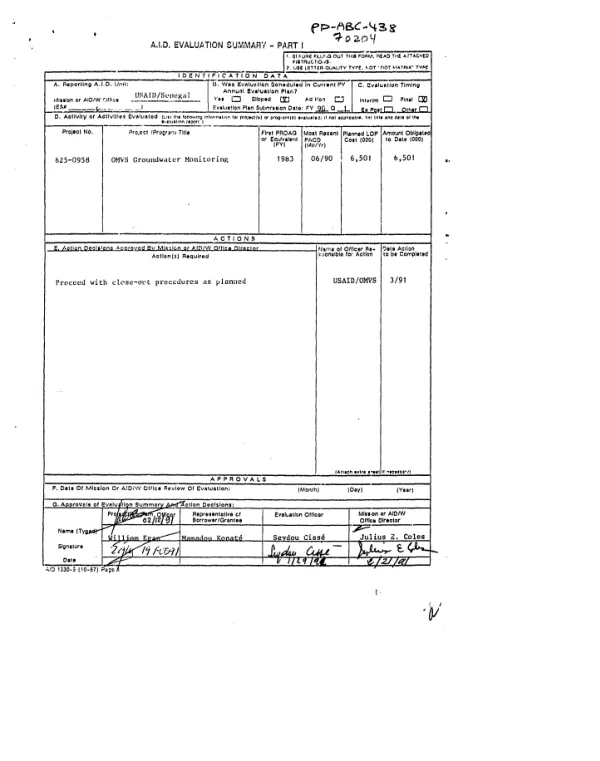
OMVS groundwater monitoring
Summarizes final evaluation (XD-ABC-438-A) of a project to help the Organisation pour la Mise en Valeur du Fleuve Senegal (OMVS) establish a groundwater monitoring unit in Saint-Louis, Senegal.
1991
Sign in to readA free account is required to download.
Abstract
External evaluation covered the period FY83-5/90. The project has successfully installed a network of piezometers to provide data on groundwater levels. Readings are taken regularly by project staff and entered into an automated data base system developed especially for the project. This system, called Gestion Eaux Souterraines (GES), is a powerful, user- friendly system for data entry and management, quality control, analysis, and report preparation. Coupled with the program Groundwater, which handles historical information about the network, and the mapping program SURFER, the system is far surpasses what was envisioned in the Project Paper. However, GES is a new program and has not been fully "debugged". Also, one of the three computers installed needs to be replaced. Debugging and computer repair are not available locally. The project has been insufficiently staffed since 7/88, resulting in a reduced impact on national staff capabilities and a less- than-desired level of analysis; while a good level of analysis has been performed on the Delta region and Manantali, similar in- depth studies on the river valleys are needed. Participant training in the United States and France has been successful in terms of skills acquired, but only two of the six trainees have continued to work with the project. Another constraint has been the closing of the Senegal-Mauritania border, which has precluded the kind of collaboration necessary for complete success as an international project. It is strongly recommended that OMVS mobilize the financial and technical resources needed to continue operating the Groundwater Monitoring Unit after the PACD. The Mission adds that the OMVS should be able to do so after 7 years of project implementation. Major lessons include the following. (1) Alternative methods may achieve as much or more success than planned in the project design. Flexibility is desirable. (2) Computers and computer programs are welcome technology, but successful establishment requires training both in use and maintenance. (3) Coordination with other agencies may require outside help and direction to maintain broad perspectives and proper orientation. (4) Decentralization is possible, if responsibilities and authority are properly delegated. (5) Trainees should be contractually obligated to return to the project or linked activities. (6) Advance guidance on administrative and accounting procedures may help keep the project on track.
Related documents