USAID DEC
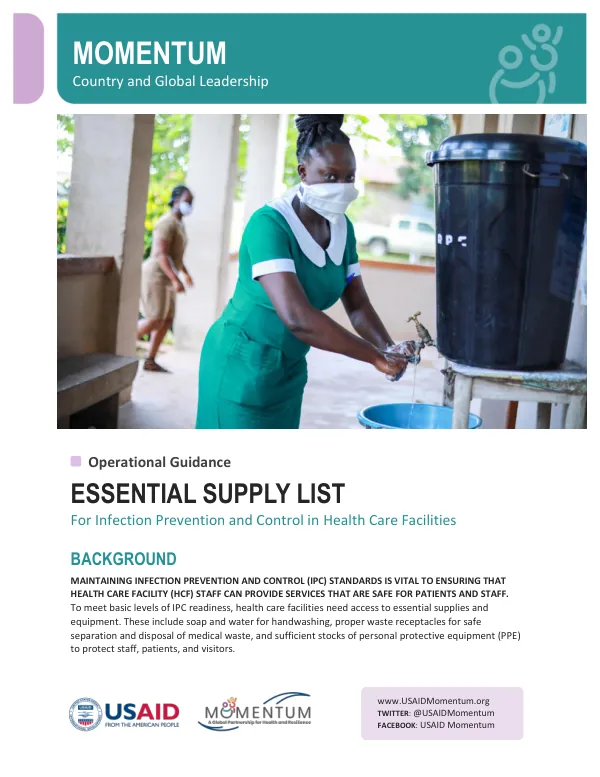
Operational Guidance - Essential Supply List for Infection Prevention and Control in Health Care Facilities
Sign inJOHNS HOPKINS UNIVERSITY
Operational Guidance - Essential Supply List for Infection Prevention and Control in Health Care Facilities
The Momentum Country and Global Leadership project aims to improve family planning and maternal and child health in partner countries around the world.
2021 · 27 pages
Sign in to readA free account is required to download.
Abstract
As part of this initiative, the project focuses on technical and capacity development assistance to ministries of health and other country partners to improve outcomes. One key aspect of this effort is maintaining infection prevention and control (IPC) standards in health care facilities (HCFs). Maintaining IPC standards is vital to ensuring that HCF staff can provide services that are safe for patients and staff. To meet basic levels of IPC readiness, HCFs need access to essential supplies and equipment, including soap and water for handwashing, proper waste receptacles for safe separation and disposal of medical waste, and sufficient stocks of personal protective equipment (PPE) to protect staff, patients, and visitors. The insufficient stocking of essential IPC supplies and equipment undermines efforts to achieve and sustain universal access to care that is safe, cost-effective, and efficient. According to a 1995-2008 review and meta-analysis, health care-associated infections developed in more than 15% of patients in limited-resource settings. Unclean environments at health facilities contribute to the emerging threat of antimicrobial resistance, and the current SARS-CoV-2 (COVID-19) pandemic acutely demonstrates the importance of investing in sustained IPC measures to protect patients and staff from preventable transmission of known and future infectious diseases. Multiple IPC guidance and standards documents have been published by various global institutions, including the World Health Organization (WHO), the WHO/UNICEF Joint Monitoring Programme for Water Supply, Sanitation and Hygiene (JMP), the Centers for Disease Control and Prevention (CDC), SPHERE, John Hopkins University, and the London School of Hygiene and Tropical Medicine. Although these documents reference specific equipment and materials necessary for implementing IPC best practices, there is no single resource that lists all essential IPC items in a format similar to the WHO's Model List of Essential Medicines. This document was developed through USAID's Momentum Country and Global Leadership project to complement existing guidance and standard documents by providing centralized global guidance on essential infection prevention supplies and equipment, along with generalized information on transmission relevance, minimum supply specifications, and recommended stocking quantities. The document includes a list of essential supplies for HCFs to maintain basic standard IPC precautions in all health care service levels and contexts. The list is non-exhaustive and focuses on the essential supplies required for IPC based on a review of the literature and available guidance. The list does not include items for treatment or procedures, such as gloves but not gauze. Although this document was not written to respond directly to the COVID-19 infectious disease pandemic, it does include essential IPC supplies required for delivery of safe health care services in the context of COVID-19. The document provides tables listing essential IPC supplies divided into technical sections, including tools and materials, personal protective equipment, environmental cleaning, instrument processing, waste management, and infrastructure and maintenance. Each table provides information on the use, applicable transmission-based precautions, specification or descriptive information of the material, and guidance on minimum quantities, as well as on stocking and refilling. In practice, this information should be contextualized according to national standards and availability of materials. The document also includes guidance on reading list tables, which provide a list of corresponding equipment, tools, and materials and a list of PPE, as detailed in the following example table. The table includes information on the use, contact, droplet, airborne, specification, quantity, tools, materials, and equipment identified as essential for IPC readiness, how the item is used, need based on transmission-based precautions, and general description for procuring items along with approximate duration/lifespan of the product. The essential infection prevention supplies listed in the document include hand hygiene materials for health care workers, such as alcohol-based hand rub and hand hygiene promotional materials, and personal protective equipment, such as gloves, masks, and eye protection. The document also includes essential supplies for environmental cleaning, instrument processing, waste management, and infrastructure and maintenance, such as cleaning agents, disinfectants, and waste disposal equipment. Overall, the document provides a comprehensive list of essential IPC supplies and equipment necessary for maintaining basic standard IPC precautions in HCFs, and can aid HCF staff, administrators, and government officials at local and national levels to better understand which IPC supplies should be prioritized for maintaining minimal IPC readiness.
Related documents
Documents in this collection
 2021
2021USAID DEC
HIV SELF-TESTING OPERATIONAL GUIDE FOR THE PLANNING, IMPLEMENTATION, MONITORING AND REPORTING OF HIV SELF-TESTING MEETING TARGETS AND MAINTAINING EPIDEMIC CONTROL (EPIC) PROJECT
Open record 2021
2021USAID DEC