USAID DEC
Operational Guidance for Maternal and Child Survival Country Programs: Pre-Service Education
Sign inJHPIEGO
Operational Guidance for Maternal and Child Survival Country Programs: Pre-Service Education
Pre-service education for health care providers is a critical component of the Maternal and Child Survival Program (MCSP).
2017 · 4 pages
Sign in to readA free account is required to download.
Abstract
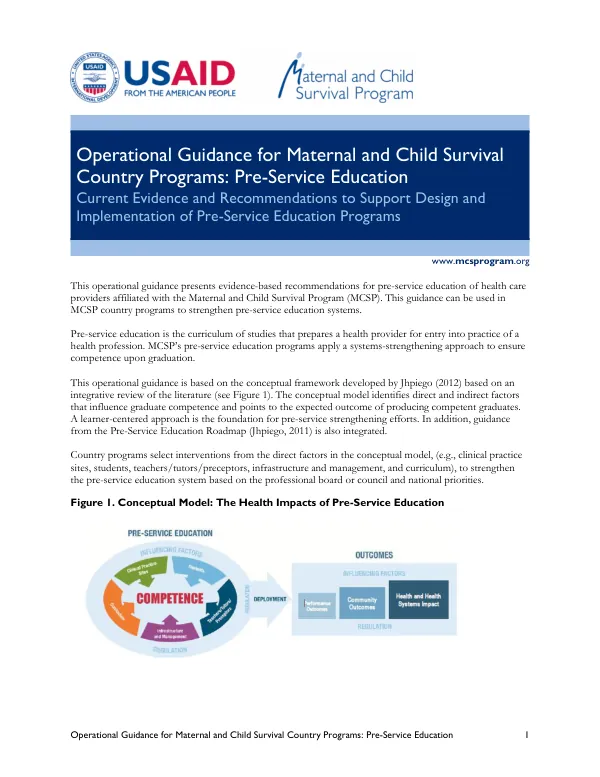
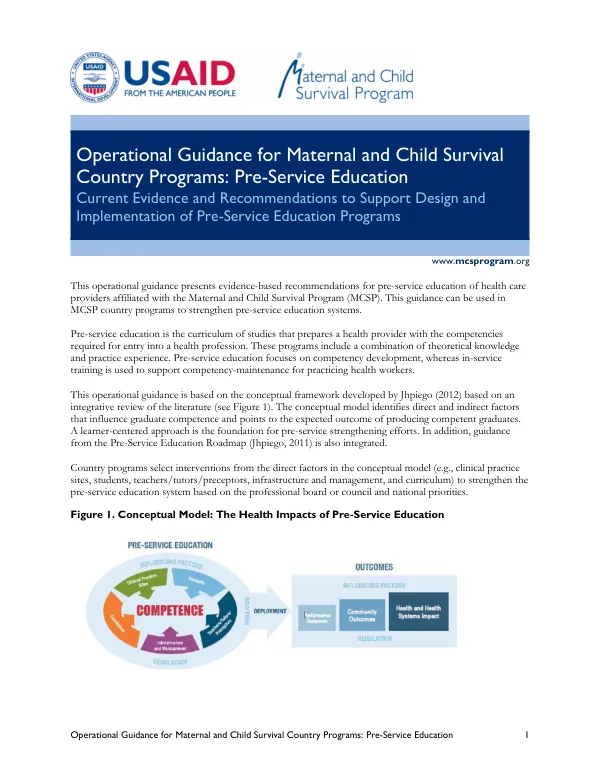
This operational guidance presents evidence-based recommendations for strengthening pre-service education systems in MCSP country programs. The guidance is based on a conceptual framework developed by Jhpiego, which identifies direct and indirect factors that influence graduate competence. The conceptual model highlights the importance of a learner-centered approach in pre-service education. This approach focuses on competency development, rather than just providing theoretical knowledge. The model also emphasizes the need for a strong faculty, adequate clinical practice opportunities, and a well-designed curriculum. The guidance integrates recommendations from the Pre-Service Education Roadmap (Jhpiego, 2011) and the Global Strategy on Human Resources for Health: Workforce 2030 (WHO, 2015). Country programs can select interventions from the direct factors in the conceptual model to strengthen the pre-service education system. These factors include students, teachers, preceptors, infrastructure and management, and curriculum. The guidance provides evidence-based recommendations for each of these factors, including targeted recruitment of qualified students, preparation and retention of skillful teachers, and the use of modern infrastructure and technology. The operational guidance also highlights the importance of clinical practice sites in pre-service education. Students must receive sufficient clinical practice opportunities in high-quality clinical learning environments to graduate with the competencies required for effective practice. Clinical sites can be strengthened through facility-based mentoring or training, use of facility-level accreditation, quality improvement efforts, or provision of infrastructure support. The guidance emphasizes the need for active engagement of students, preceptors, and teachers in student practice and formative and summative assessments. Expanding access and exposure to a variety of clinical practice sites and strengthening clinical practice sites are critical investments for competency development. The operational guidance provides a summary of priority interventions for each component of the conceptual model. These interventions include expanded clinical sites, more clinical rotations, strengthened clinical site services and infrastructure, strengthened selection and recruitment, student support measures, and pre-deployment preparation. The guidance also highlights the importance of faculty development, preceptor preparation and training, and the use of information and communication technology in teaching. Overall, the operational guidance provides a comprehensive framework for strengthening pre-service education systems in MCSP country programs. By implementing these evidence-based recommendations, country programs can improve the quality of pre-service education and produce competent health care providers who can deliver high-quality health services. The Maternal and Child Survival Program (MCSP) has used task analysis to identify the appropriate skill mix based on national health priorities. For example, in Ghana and Liberia, the program has identified the need for health care providers to have skills in maternal and child health, as well as in emergency obstetric care. The program has also used competency-based education to ensure that health care providers have the necessary skills and knowledge to provide high-quality health services. The operational guidance emphasizes the importance of educational regulation and licensure in ensuring quality health services. The Global Strategy on Human Resources for Health: Workforce 2030 (WHO, 2015) highlights the importance of educational regulation and licensure in ensuring quality health services. However, there is limited evidence specifically on the evidence behind regulation. The guidance also highlights the need for a well-designed curriculum that is based on national health priorities. The curriculum should include formative and summative assessment of student learning, particularly for high criticality skills. The use of objective, structured clinical examinations is of particular value in assessing student learning.