USAID DEC
Operational Guidance for Maternal and Child Survival Country Programs: Pre-Service Education
Sign inJHPIEGO
Operational Guidance for Maternal and Child Survival Country Programs: Pre-Service Education
Pre-service education for health care providers is a critical component of the Maternal and Child Survival Program (MCSP).
2017 · 4 pages
Sign in to readA free account is required to download.
Abstract
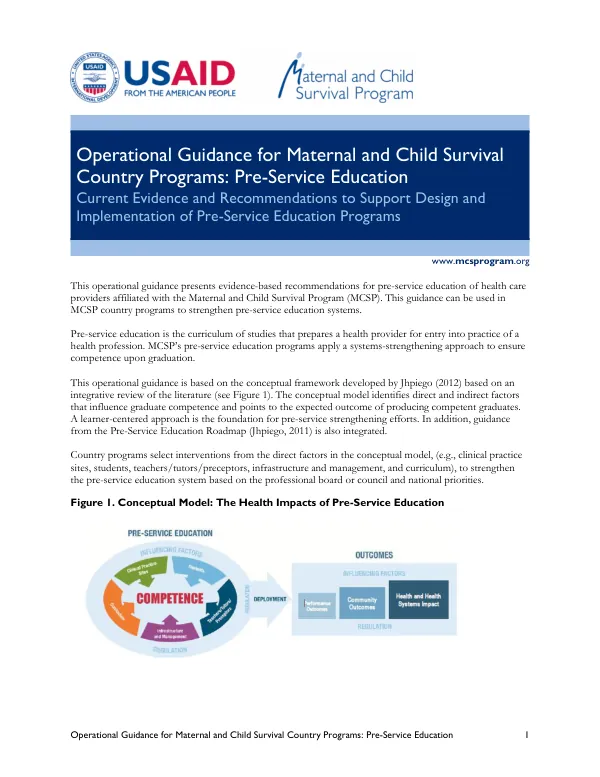
This operational guidance presents evidence-based recommendations for strengthening pre-service education systems in MCSP country programs. The guidance is based on a conceptual framework developed by Jhpiego (2012) and integrates guidance from the Pre-Service Education Roadmap (Jhpiego, 2011). The conceptual model identifies direct and indirect factors that influence graduate competence and points to the expected outcome of producing competent graduates. A learner-centered approach is the foundation for pre-service strengthening efforts. Country programs select interventions from the direct factors in the conceptual model, such as clinical practice sites, students, teachers/tutors/preceptors, infrastructure and management, and curriculum, to strengthen the pre-service education system based on professional board or council and national priorities. A new report by the UN High-Level Commission on Health Employment and Economic Growth highlights the critical need to invest in human resources for health. The global Human Resources for Health 2030 strategy calls for scaling up transformative, high-quality education and lifelong learning to ensure that all health workers have skills that match the health needs of populations and can work to their full potential. Jhpiego performed an integrative review of the literature to analyze factors contributing to quality pre-service education. The findings from this literature review are summarized below. Targeted recruitment of qualified students from rural and low-resource settings appears to be a particularly effective strategy for retaining students in vulnerable communities after graduation. Rural rotations increase students' comfort and possible willingness for rural deployment. An applicant's expression of interest in the profession was important for student retention, but often not part of student selection. Student support, including financial, peer, and gender support, helps reduce attrition. Pre-deployment objective-structured clinical examinations or refreshers help ensure adequate clinical skills. Preparation and retention of skillful teachers are essential, and teacher retention is often an issue due to low salary scales. The role of the preceptor and preceptors' skills in clinical teaching are of critical importance, and using a learner-centered approach to identify student learning needs, assess student learning, and prioritize time management are particularly important. Modern, Internet-enabled medical libraries, skills and simulation laboratories, and computer laboratories to support computer-aided instruction are elements of infrastructure meriting strong consideration. Skill labs are particularly important when access to clients is limited. Internet-based learning has been extensively studied, and several meta-analyses indicate that it can be as effective as traditional classroom-based learning in terms of student satisfaction and knowledge acquisition. The health workforce must be well prepared to address national health priorities. MCSP has used task analysis to identify the appropriate skill mix based on national health priorities. Evidence supports a competency-based curriculum, but there is no clear evidence supporting specific curricular models such as problem-based or team-based learning. Formative and summative assessment of student learning, in particular for high criticality skills, is essential for competency development. All students must receive sufficient clinical practice opportunities in high-quality clinical learning environments in order to graduate with the competencies required for effective practice. Clinical sites may be strengthened through facility-based mentoring or training, use of facility-level accreditation, quality improvement efforts, or provision of infrastructure support. A wide variety of settings is useful to provide students the individual learning opportunities they require, given the lower frequency of occurrence of certain clinical conditions and because of a high volume of students of various health occupations and professions who may be seeking similar experiences in a simultaneous timeframe. Regulation is widely viewed as essential to public protection, but there is limited literature specifically on the evidence behind regulation. Globally, governments and the public recognize how important regulation is for ensuring educational quality and continued competence for the health workforce. This is reinforced in the Global Human Resources for Health 2030 strategy, which highlights the importance of educational regulation and licensure in ensuring quality health services. Strengthening pre-service education systems in MCSP programs is dependent on the gaps identified and national priorities. Figure 2 summarizes priority interventions, based on the evidence, for each component of the conceptual model. These interventions include expanded and varied clinical sites, more clinical rotations to increase access to clients, strengthened clinical site services and infrastructure, strengthened selection and recruitment, student support measures, pre-deployment preparation, faculty development, site-based refresher clinical training, preceptor preparation and training, strengthened use of ICT in teaching, skill lab support, computer lab and learning resources access, leadership and management development, rapid task analysis, competency-based curriculum update, rational integration of use of ICT, and leverage of open-source digital content.
Related documents