WHO
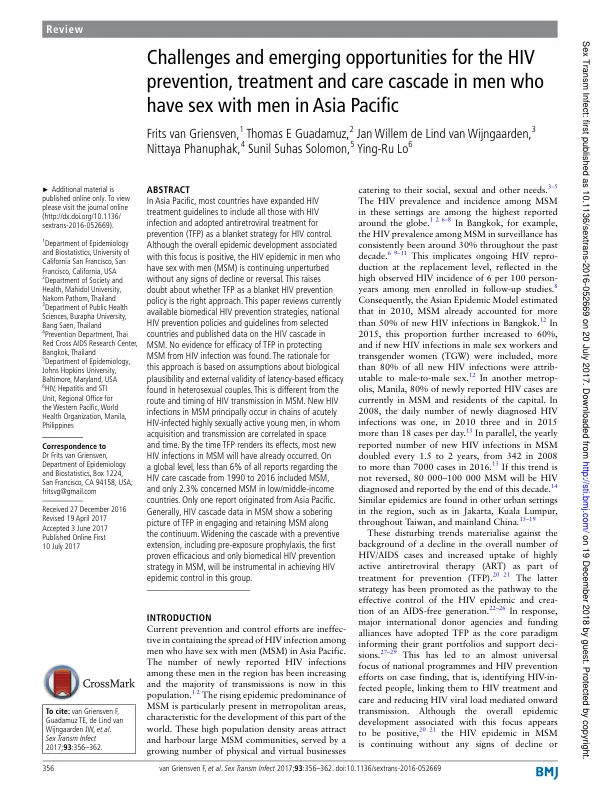
Optimising treatment in the test-and-treat strategy: what are we waiting for?
The test-and-treat strategy, introduced in 2009, encompasses early and frequent HIV testing and immediate antiretroviral therapy (ART) provision to individuals diagnosed with HIV infection.
2019 · 8 pages
Sign in to readA free account is required to download.
Abstract
The strategy aims to curb the HIV epidemic by suppressing viral load and reducing HIV transmission. However, its implementation has been hindered by various challenges, including inadequate health infrastructure, poor economics, and discrimination against key populations. Mathematical modeling has been used to demonstrate the potential benefits of the test-and-treat strategy. In 2002, Velasco-Hernandez and colleagues published a mathematical model showing that high ART coverage could eradicate the HIV epidemic in the San Francisco gay community. Subsequent studies have confirmed the effectiveness of the strategy, with a 57% reduction in AIDS and non-AIDS-related mortality when ART is started at any CD4 count. Despite the evidence, the test-and-treat strategy has not been universally adopted. In 2015, the World Health Organization (WHO) updated its guidelines to recommend ART initiation for all individuals living with HIV, regardless of CD4 count. However, as of mid-2017, only 60% of low-income and middle-income countries (LMICs) had adopted the test-and-treat policy, and 40% had put it into full practice. The implementation of the test-and-treat strategy has been hindered by various challenges, including inadequate health infrastructure, poor economics, and discrimination against key populations. In 2018, Indonesia and Russia, countries with high HIV burdens, only adopted the test-and-treat policy. The scarcity of political commitment and will has also hindered implementation. The test-and-treat strategy must be implemented efficiently to optimize its benefits. Emerging evidence suggests that test and treat alone may only bring down the number of new HIV infections to a certain level. To achieve true impact on HIV control, rapid roll-out of pre-exposure prophylaxis (PrEP) must be integrated with test and treat. The test-and-treat strategy has been shown to reduce HIV transmission among serodiscordant couples and men who have sex with men (MSM). However, its implementation has been hindered by various challenges, including inadequate health infrastructure, poor economics, and discrimination against key populations. To achieve true impact on HIV control, rapid roll-out of PrEP must be integrated with test and treat. The test-and-treat strategy has been shown to reduce HIV transmission among serodiscordant couples and MSM. However, its implementation has been hindered by various challenges, including inadequate health infrastructure, poor economics, and discrimination against key populations. To achieve true impact on HIV control, rapid roll-out of PrEP must be integrated with test and treat.