USAID
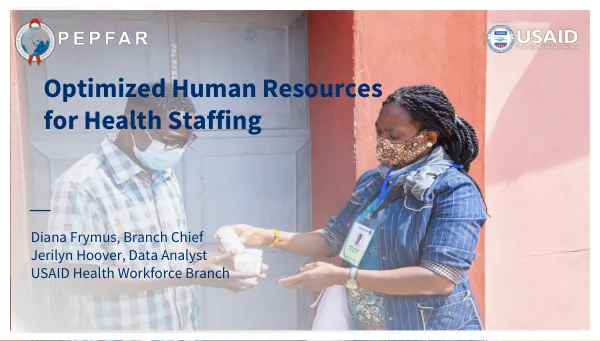
Optimized Human Resources for Health Staffing
The USAID Health Workforce Branch, in collaboration with the PEPFAR HRH technical priorities, has been working to optimize human resources for health staffing.
2021 · 59 pages
Sign in to readA free account is required to download.
Abstract
This effort aims to address critical gaps in the health workforce, particularly in areas where HIV service delivery is essential. Historically, PEPFAR has invested significantly in the health workforce, with a Congressional mandate achieved in 2014 to train and retain 140,000 new health care professionals and paraprofessionals. The PEPFAR 3.0 HRH Strategy, launched in 2015, focused on addressing facility and community-level HRH gaps. In 2017, intensified strategies were implemented to achieve and sustain epidemic control, including additive and surge HRH personnel investments across countries. As of FY20, USAID IPs employed over 90,000 health workers worldwide across clinics and communities for HIV service delivery. PEPFAR supported 90,268 health workers across facilities and communities worldwide, with 58% being lay workers and 16% clinical staff. These workers have enabled rapid adaptation of HIV services during the COVID-19 pandemic and have been leveraged to support the COVID response. Countries have reported service delivery delays due to fear among health workers in areas with inadequate personal protective equipment (PPE). Health workers have contracted COVID-19 and faced violence during the pandemic. In response, many countries have reconfigured HRH staff to support HIV service delivery during COVID, including decanting facilities, using community workers and mobile health teams, expanding telehealth use, and providing virtual training and supervision. The macroeconomic impact of COVID-19 has affected resource availability for HRH wages, risk allowance, and hiring in some countries. To address this, there is a need to increase focus on more optimized use of HRH staffing, including community workers, to yield efficiencies and ease resource gaps. The average staffing expenditure is 44% of total USAID reported expenditures across 9 OUs, highlighting the importance of ensuring optimized staffing patterns and alignment to targets. Data is crucial for HRH optimization, and several key areas need to be addressed. These include understanding the staffing composition across mechanisms (both prime and sub) by category of staff and distribution across OUs, identifying the roles of staff providing service delivery and those supporting non-service delivery/technical assistance, and examining how staffing distribution aligns to program targets and target achievement. Additionally, staff changes made due to COVID-19 and the pandemic's impact on staffing need to be monitored and analyzed. PEPFAR has several reporting requirements for HRH data, including the MER: HRH_CURR, which captures the number of health workers working on HIV-related activities and receiving support from PEPFAR, as well as total spend on these workers. However, this data source has limitations, including only capturing staff providing services to HIV clients and lumping distinct cadres into broad categories. Expenditure reporting and HRH inventories are also used to collect HRH data, but these sources have their own limitations and are not yet standardized across OUs.
Related documents