USAID DEC
Optimizing treatment for the prevention of pre-eclampsia/eclampsia in Nepal: is calcium supplementation during pregnancy cost-effective?
Sign inJHPIEGO
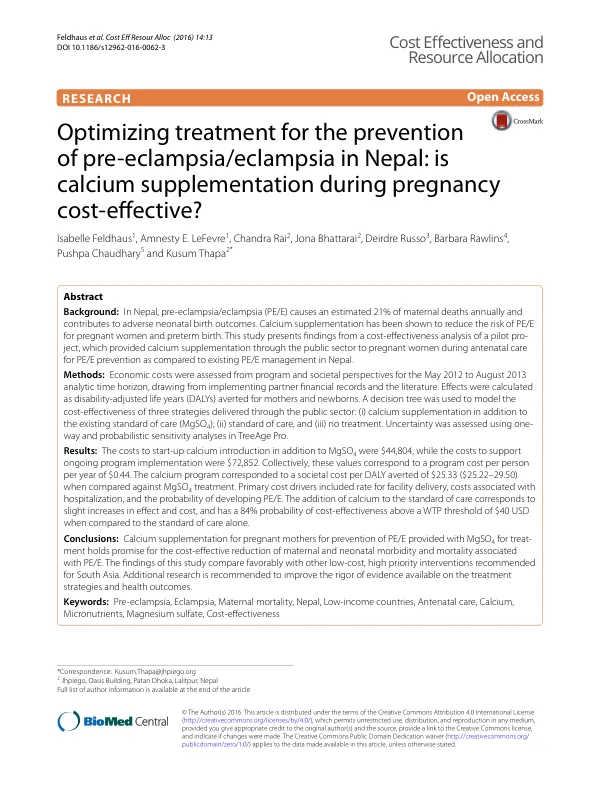
Optimizing treatment for the prevention of pre-eclampsia/eclampsia in Nepal: is calcium supplementation during pregnancy cost-effective?
Pre-eclampsia/eclampsia (PE/E) is a leading cause of maternal mortality in Nepal, accounting for an estimated 21% of maternal deaths annually.
2016 · 15 pages
Sign in to readA free account is required to download.
Abstract
The condition is also associated with adverse neonatal outcomes, including higher rates of neonatal intensive care unit admission and length of stay, small for gestational age, stillbirth, and mortality. In Nepal, eclampsia is the leading direct cause of maternal mortality, occurring in 1 in 25 women. Calcium supplementation has been shown to reduce the risk of PE/E for pregnant women and preterm birth. The World Health Organization recommends that 1.5-2.0 g of calcium be taken daily during pregnancy for the prevention of PE/E, beginning at a gestational age of approximately 20 weeks. In multiple clinical trials, low-dose calcium supplementation has been shown to reduce the risk of PE/E for pregnant women and preterm birth. A pilot program was implemented in Dailekh District in the Mid-Western Region of Nepal to test the feasibility of providing calcium supplements to pregnant women to prevent PE/E. The program was implemented from May 2012 through August 2013, with technical support from the USAID-funded Maternal and Child Health Integrated Program (MCHIP) and Jhpiego. The program aimed to evaluate the incremental cost-effectiveness of calcium supplementation for PE/E prevention as compared to existing curative PE/E management in Nepal. The costs to start-up calcium introduction in addition to magnesium sulfate (MgSO4) were $44,804, while the costs to support ongoing program implementation were $72,852. Collectively, these values correspond to a program cost per person per year of $0.44. The calcium program corresponded to a societal cost per disability-adjusted life year (DALY) averted of $25.33 ($25.22-$29.50) when compared against MgSO4 treatment. Primary cost drivers included the rate for facility delivery, costs associated with hospitalization, and the probability of developing PE/E. The addition of calcium to the standard of care corresponds to slight increases in effect and cost, and has an 84% probability of cost-effectiveness above a willingness-to-pay (WTP) threshold of $40 USD when compared to the standard of care alone. The findings of this study compare favorably with other low-cost, high-priority interventions recommended for South Asia. Additional research is recommended to improve the rigor of evidence available on the treatment strategies and health outcomes.
Related documents