AVENIR HEALTH
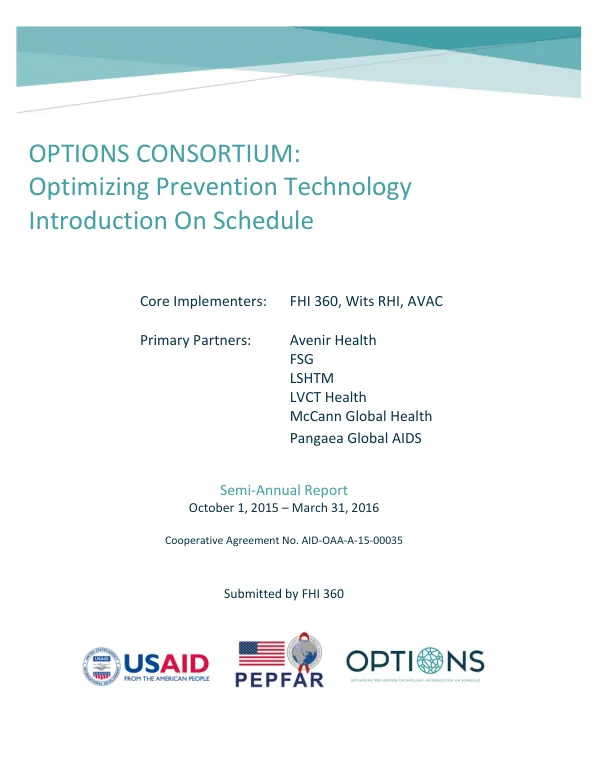
OPTIONS Consortium: Optimizing Prevention Technology Introduction On Schedule
The OPTIONS Consortium, Optimizing Prevention Technology Introduction ON Schedule, is a cooperative agreement between FHI 360 and USAID.
2016 · 43 pages
Sign in to readA free account is required to download.
Abstract
The consortium aims to optimize the introduction of antiretroviral-based prevention products, including oral pre-exposure prophylaxis (PrEP) and microbicides. The agreement is effective from October 1, 2015, to March 31, 2016, and is funded by USAID under Cooperative Agreement No. AID-OAA-A-15-00035. The consortium consists of core implementers FHI 360, Wits RHI, and AVAC, as well as primary partners Avenir Health, FSG, LSHTM, LVCT Health, McCann Global Health, and Pangaea Global AIDS. The OPTIONS Consortium is focused on introducing ARV-based prevention products in several countries, including Kenya, South Africa, and Zimbabwe. The consortium's progress toward its objectives is reported in the semi-annual report. Activity 1 involves the development of evidence-based business cases and a coordinated investment strategy for ARV-based prevention product introduction. This includes value chain situation analyses for oral PrEP, investment scenarios for oral PrEP, demand creation and communication market shaping strategy, modeling activities, and Go/No-Go decisions. In Activity 2, the consortium supports country-level regulatory approval, policy development, program planning, marketing, and implementation strategies for ARV-based prevention product introduction. The report highlights progress in Kenya, South Africa, and Zimbabwe, with a focus on regulatory approval, policy development, and program planning. Activity 3 involves facilitating and conducting implementation science to advance the introduction of and access to microbicides and ARV-based prevention technologies. This includes implementation science, process documentation, and the development of an ARV-Based Product Introduction Clearinghouse. The consortium also provides technical assistance and support for health systems strengthening with rapid use of data to identify and address implementation bottlenecks throughout the value chain. This is reported in Activity 4, which includes ARV-Based Product Introduction Clearinghouse and Health Systems Strengthening (HSS) Activities. In Activity 5, the OPTIONS Cross-cutting Activities and Extended Partner Engagement are reported, including MPii Coordination Activities, Extended Network Engagement, OPTIONS Communication Activities, and Finalizing Administrative Start-up Activities. The report also highlights the importance of gender integration, human subjects protection, and environmental compliance. The consortium has made significant progress in the first six months of the agreement, with several success stories reported. These include the ICASA 2015 Satellite Session on oral PrEP and media coverage and publications on the topic. The report also highlights the importance of documentation of best practices, including early engagement with USAID global and local missions, early engagement at the country level, and early development of cross-project coordination systems. The planned activities for the next performance period include value chain situation analyses and investment scenarios, communications market shaping strategy, modeling activities, and Dapivirine ring next steps. The report concludes with an updated M&E indicators table and an AVAC Twitter feed for the OPTIONS-hosted ICASA 2015 satellite session on PrEP.