CATHOLIC RELIEF SERVICES ORGANIZATION
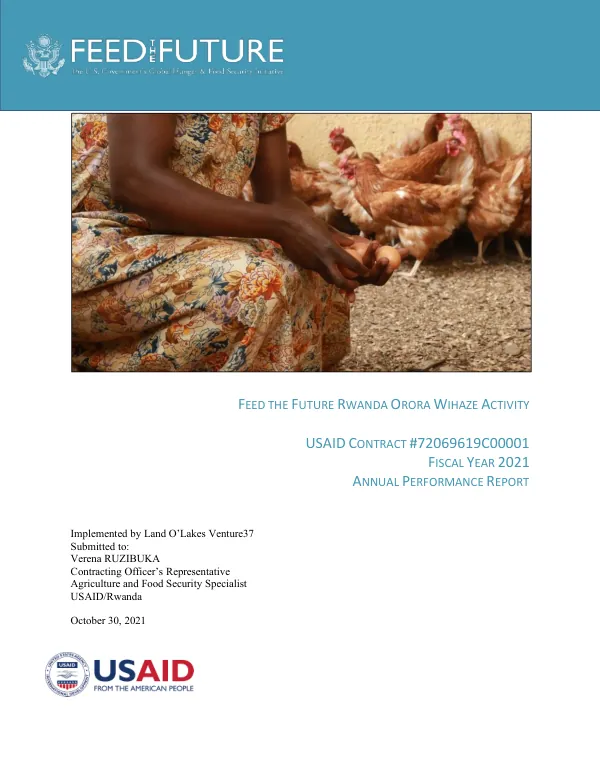
Orora Wihaze Annual Performance Report, October 2020 – September 2021
The Feed the Future Rwanda Orora Wihaze Activity is a USAID-funded program implemented by Land O'Lakes Venture37 in collaboration with consortium partners.
2021 · 42 pages
Sign in to readA free account is required to download.
Abstract
The program aims to sustainably increase the availability of, access to, and consumption of animal-sourced foods (ASF) through the development of a profitable market. The goal is achieved by implementing two objectives: 1) Strengthen Private Sector-Led ASF Value Chains and 2) Increase Demand for ASF Consumption for Women and Children. The program is implemented in eight districts of Rwanda, including Burera, Gakenke, Nyamagabe, Nyamasheke, Rutsiro, Ngororero, Kayonza, and Ngoma. During the second year of the program, staff continued market facilitation and linkages, and several partnerships with market actors were continued or launched. The program supported various activities, including the African Solutions Ltd. Outgrower Model in Kayonza, Rwanda Council of Veterinary Doctors Extension Services, National Childhood Development Agency Nutrition Policy, and Rwanda Interfaith Council on Health ASF Consumption Messaging. In addition to these activities, the program provided ongoing facilitation activities driven by stakeholder demands, including value chain platform meetings, district-facilitated trainings of producer groups, and linkage meetings between market actors. These activities led to the development and implementation of new partnerships, including OX Delivers Delivery Services in Nyamasheke, Development of an Egg Collection and Distribution Center in Gakenke, Urunana Dissemination of ASF Messaging, and Memorandum of Understanding with Rwanda Youth in Agriculture Forum. The program's main implementation results include the development and implementation of new partnerships, facilitation of linkages between market actors, and the roll-out of Activity Design Documents. The program also provided training and capacity-building activities for market actors, including producer groups and financial institutions. The program's achievements and results are summarized in the annual performance report, which includes the results indicator table, policy milestones, Environmental Mitigation and Monitoring Report, and a success story. The program's geographic focus is on the eight districts of Rwanda, where the program is implemented. The program's timeframes are from October 1, 2020, to September 30, 2021, corresponding to the second year of the program. The program's recommendations for future implementation include continued facilitation of linkages between market actors, development of new partnerships, and implementation of new activities to increase the availability of, access to, and consumption of ASF. The program's implementation details include the development and implementation of new partnerships, facilitation of linkages between market actors, and the roll-out of Activity Design Documents. The program's management and administration include the coordination of activities among consortium partners, management of finances and resources, and monitoring and evaluation of program progress. The program's Monitoring, Evaluation, and Learning (MEL) activities include the collection and analysis of data on program progress, monitoring of program indicators, and evaluation of program impact. The program's Collaboration, Learning, and Adapting (CLA) activities include the facilitation of stakeholder engagement, coordination of activities among consortium partners, and the sharing of knowledge and best practices among program stakeholders. The program's challenges and lessons learned include the impact of COVID-19-related lockdowns and restricted travel on program implementation, the need for continued facilitation of linkages between market actors, and the importance of monitoring and evaluation of program progress.