CATHOLIC RELIEF SERVICES ORGANIZATION
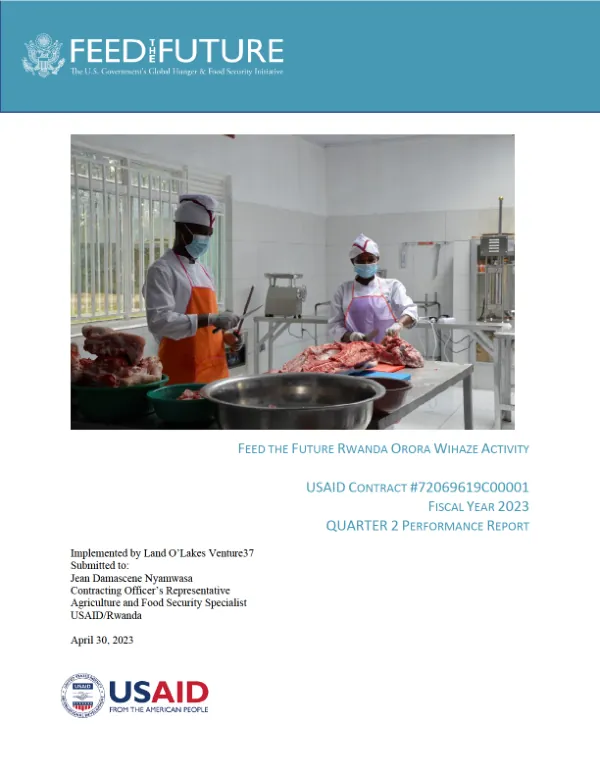
Orora Wihaze Quarter 2 Performance Report, January 2023 – March 2023
The Feed the Future Rwanda Orora Wihaze Activity is a four-year initiative implemented by Land O'Lakes Venture37 in collaboration with consortium partners.
2023 · 32 pages
Sign in to readA free account is required to download.
Abstract
The goal of Orora Wihaze is to sustainably increase the availability of, access to, and consumption of animal sourced foods (ASF) through the development of a profitable market. This is achieved by implementing two objectives: 1) Strengthen Private Sector Led ASF Value Chains and 2) Increase Demand for ASF Consumption for Women and Children. During the second quarter of the fourth year, Orora Wihaze achieved significant results. The activity has established a functional approach to engaging the ASF sector, leading to an improved enabling environment for ASF businesses. This has resulted in significant investment in the sector, with key indicator targets showing results. The activity deploys an active internal learning and reflection process that informs required adaptations for activities in implementation and consideration for scaling opportunities. Key results achieved by the end of Year 4 Quarter 2 include: 19,505 individuals participated in USG food security programs, including 7,831 new participants, bringing the cumulative total to 74,306 individuals over the Life of Activity (LOA) as of the end of Y4Q2. Of these participants, 64.6% were women, and 27.2% were youth. Activity partners accessed loans amounting to USD $626,918 from financial institutions throughout the quarter, bringing the cumulative total to USD $2,136,676 in financing, which exceeds the LOA target of USD $1,300,000 by 64.4%. Activity partner enterprises made sales totaling USD $1,776,862, including sales from Community Based Saving Groups (CBSGs), cooperatives, and other enterprises. The activity has also made progress in increasing demand for ASF consumption for women and children. Through trainings, Village Nutrition School (VNS) sessions, business linkage meetings, and home visits, Orora Wihaze has reached a significant number of individuals, including women and youth, and has provided them with the necessary skills and knowledge to improve their livelihoods. The activity's progress has been made possible through the collaboration of its partners, including Catholic Relief Services (CRS), MarketShare Associates (MSA), The Manoff Group (TMG), and Urunana Development Communications (Urunana). The activity's success has also been facilitated by the support of the American people through the United States Agency for International Development (USAID). Overall, the second quarter of the fourth year has been a significant milestone for Orora Wihaze, with the activity achieving its objectives and making progress towards its goal of sustainably increasing the availability of, access to, and consumption of animal sourced foods (ASF) in Rwanda. The activity's focus on strengthening private sector-led ASF value chains has led to significant investment in the sector, with key indicator targets showing results. The activity's efforts to increase demand for ASF consumption for women and children have also been successful, with a significant number of individuals, including women and youth, participating in the activity's programs. The activity's progress has been made possible through the collaboration of its partners and the support of the American people through USAID. The activity's success has also been facilitated by the support of the Government of Rwanda, which has provided the necessary enabling environment for the activity to operate effectively. The activity's achievements in the second quarter of the fourth year are a testament to the effectiveness of the Market Systems Development (MSD) approach, which has been used to implement the activity's objectives. The MSD approach has enabled the activity to engage with the private sector and civil society organizations to develop a profitable market for ASF, which has led to significant investment in the sector and improved livelihoods for individuals, including women and youth. The activity's progress has also been facilitated by the use of technology, including mobile phones and digital platforms, which have enabled the activity to reach a wider audience and provide them with the necessary skills and knowledge to improve their livelihoods.