USAID DEC
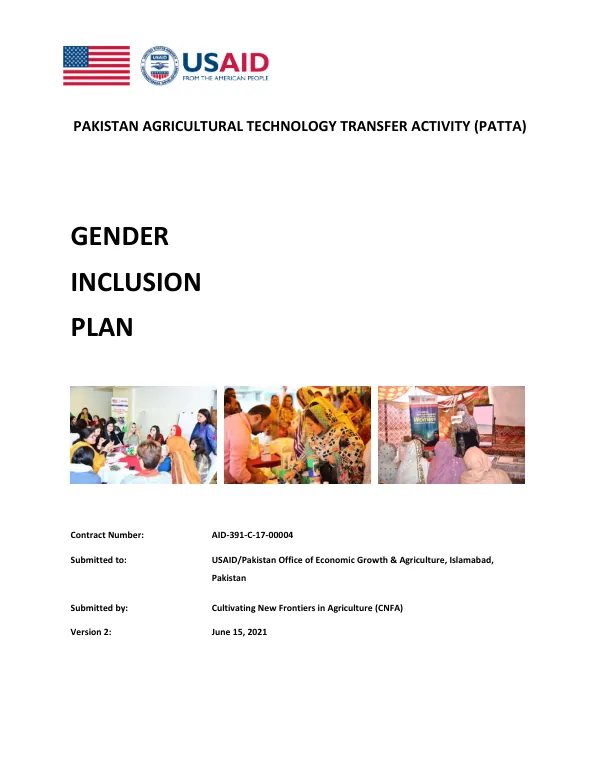
Pakistan Agricultural Technology Transfer Activity (PATTA) Gender Inclusion Plan – Version II
Sign inCULTIVATING NEW FRONTIERS IN AGRICULTURE
Pakistan Agricultural Technology Transfer Activity (PATTA) Gender Inclusion Plan – Version II
The Pakistan Agricultural Technology Transfer Activity (PATTA) aims to promote and commercialize agricultural technologies among smallholder farmers in Pakistan.
2021 · 16 pages
Sign in to readA free account is required to download.
Abstract
PATTA is a USAID-funded project that facilitates productive linkages between Supply Side Partners (SSPs) and Demand Side Partners (DSPs) to promote the use of new agricultural technologies. The project focuses on enhancing farmers' production and profits by increasing awareness and adoption of innovative technology products. PATTA's Gender Inclusion Plan proposes a strategy for integrating gender equality and women empowerment throughout the project duration. The plan is underpinned by a strong outreach component, building on the principles of Gender Equality and Women Empowerment. PATTA is committed to ensuring that women in agriculture have access to and understanding of agriculture and livestock technologies. The plan builds on a gender analysis conducted by CNFA during the proposal development phase and secondary research available from official government documents, USAID gender integration guidelines, and relevant reports of donor agencies. To ensure that gender integration is incorporated as an integral component of the project planning, design, implementation, and monitoring and evaluation, PATTA has taken several actions. Project management incorporates a gender perspective in all project activities during the planning, implementation, and monitoring stages. PATTA's SSPs focus on gender inclusion at the design and implementation phase, and concerted efforts are made to identify champion female leaders amongst the project stakeholders for direct and indirect support. The inclusion of women farmers in PATTA's activities, especially agriculture technology transformation and promotion-related activities, is a key component of PATTA's Gender Inclusion Plan. PATTA's Gender Inclusion Plan aims to create more entrepreneurial opportunities and a women-friendly work environment for women in agriculture technology businesses. The plan promotes technologies that reduce gender inequalities and identifies barriers to the promotion of technologies for farmers and women entrepreneurs. PATTA is also collecting gender-disaggregated data and monitoring the gender impacts of technologies on women and impact on agriculture. The project expects to leverage at least USD 5.64 million in private sector capital investment and increase sales of Agri-technologies by USD 31.60 million. The project aims to create a minimum of 3,515 full-time equivalent (FTE) jobs, generated when small farmers transition from subsistence livelihood to commercial production. A total of 630 MSMEs will benefit from PATTA's customized capacity building and technical assistance to expand their workforce. The activity will commercialize at least 500 technologies and practices, and this will be highlighted through effective marketing campaigns, demonstration activities, and dissemination initiatives. As a result of this integrated approach, it is expected that at least 304,000 stakeholders (20% females) will benefit by demonstrating knowledge of project-supported technologies; 132,506 small farmers (20% women farmers) will utilize these technologies, and the value of their sales will reach USD 8.58 million. PATTA is complying with USAID's Gender Equality and Female Empowerment (GEFE) Policy and USAID's ADS Chapter 205 "Integrating Gender Equality and Female Empowerment in USAID's Program Cycle" into all relevant aspects of activity programming. PATTA is promoting women Agri-entrepreneurs at provincial, national, and international levels, and women are availing agriculture technology-related business opportunities in Gilgit Baltistan (GB), Khyber Pakhtunkhwa (KP), Sindh, Punjab, and Balochistan.