USAID DEC
USAID's Natural Wealth Program: Innovative Strategies for Conservation and Sustainable Development in Colombia
Sign inCHEMONICS
USAID's Natural Wealth Program: Innovative Strategies for Conservation and Sustainable Development in Colombia
Colombia's natural and cultural richness is threatened by socio-environmental conflicts.
2020 · 4 pages
Sign in to readA free account is required to download.
Abstract
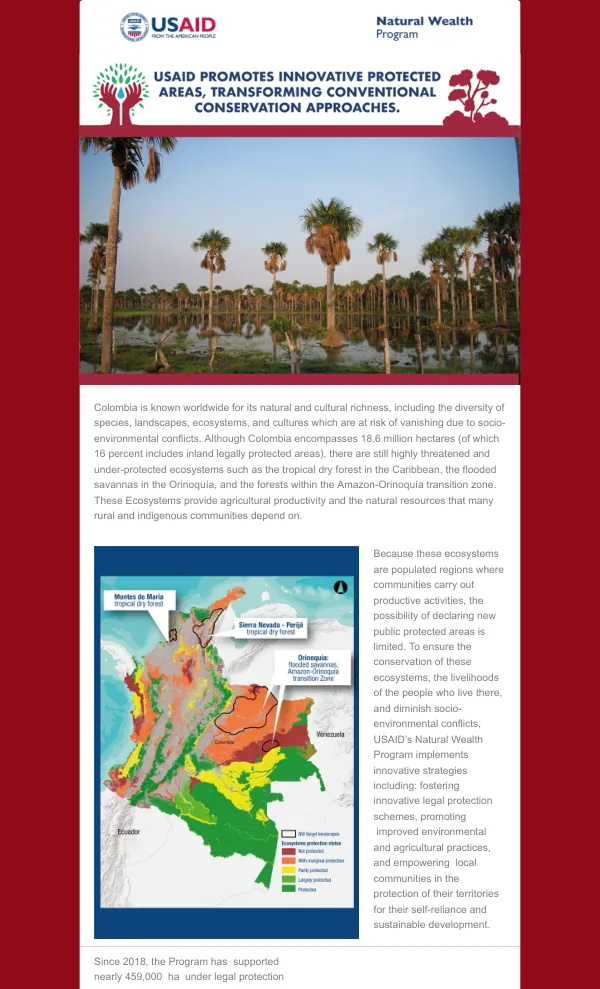
The country encompasses 18.6 million hectares, with 16 percent consisting of inland legally protected areas. However, highly threatened and under-protected ecosystems, such as the tropical dry forest in the Caribbean, the flooded savannas in the Orinoquía, and the forests within the Amazon-Orinoquía transition zone, remain vulnerable. These ecosystems provide agricultural productivity and natural resources essential for rural and indigenous communities. The possibility of declaring new public protected areas is limited due to the presence of populated regions where communities engage in productive activities. To ensure the conservation of these ecosystems and the livelihoods of the people who live there, USAID's Natural Wealth Program implements innovative strategies. The Program fosters innovative legal protection schemes, promotes improved environmental and agricultural practices, and empowers local communities in the protection of their territories for self-reliance and sustainable development. Since 2018, the Program has supported nearly 459,000 hectares under legal protection, working on three conservation and protection schemes. The first scheme involves supporting Indigenous and Community Conservation Areas (ICCAs) and conservation areas adopted by indigenous governments. In the Orinoquía, the Arhuaco people and the Caño Mochuelo indigenous communities registered Colombia's first two ICCAs, adding more than 55,000 hectares. The Arhuaco community incorporated 15,000 hectares of tropical dry forest areas to conserve water sources, sacred areas, and fauna and flora species. This territory is part of the water recharging area upon which more than 500,000 people living in the department of Cesar are dependent. The second scheme involves strengthening private conservation clusters through the registration of Civil Society Natural Reserves. With Natural Wealth's and local partners' support, rural communities have registered 52 farms as private natural reserves, totaling more than 41,000 hectares under legal protection. These new reserves represent 20 percent of the total private reserves registered in the country in the last 20 years. Farmers have turned their properties into places that ensure connectivity between forest patches, flooded savannas, and riparian forests. The third scheme involves supporting the Government of Colombia in the declaration of a protected area – Cinaruco – which allows its inhabitants to use the area's natural resources sustainably. This area protects more than 300,000 hectares of flooded savannas and riparian forests in the Orinoquía. Cinaruco marked a milestone that can guide the future declaration of national public protected areas. This conservation effort is key for the preservation of indigenous peoples and cultures and the local "llanero" farmer culture. It aims to diminish conflicts over the use of the territory and to improve the living conditions of the local communities. The conservation and legal protection schemes promoted by the Natural Wealth Program are derived from close work with the communities that inhabit the most threatened and least protected ecosystems in the country. This work with indigenous, rural communities, and the Government of Colombia has the potential to effectively conserve biodiversity and provides the tools for sustainable development to local communities on their journey to self-reliance and the protection of their natural resources.
Related documents