USAID DEC
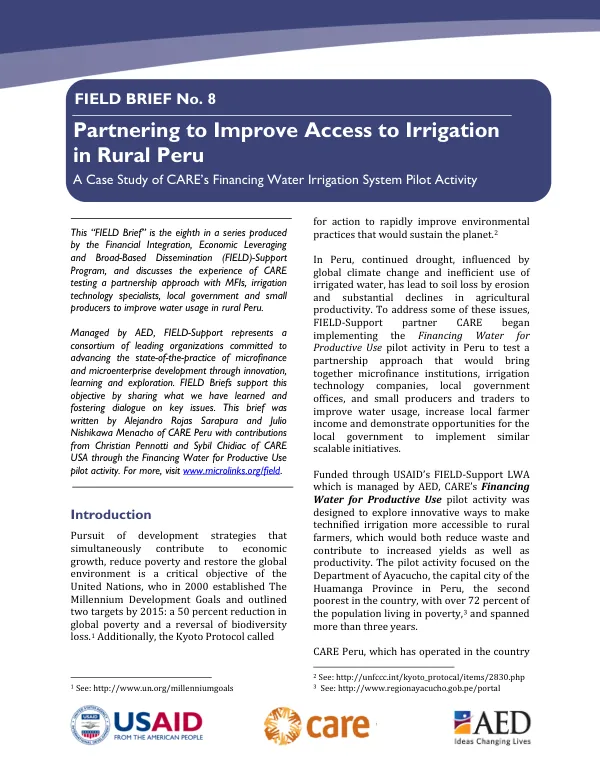
Partnering to Improve Access to Irrigation in Rural Peru: A Case Study of CARE’s Financing Water Irrigation System Pilot Activity
Sign inAED
Partnering to Improve Access to Irrigation in Rural Peru: A Case Study of CARE’s Financing Water Irrigation System Pilot Activity
The Financing Water for Productive Use pilot activity in Peru was designed to explore innovative ways to make technified irrigation more accessible to rural farmers, which would both reduce waste and contribute to increased yields and productivity.
2010 · 7 pages
Sign in to readA free account is required to download.
Abstract
The pilot activity was implemented in the Department of Ayacucho, the second poorest in the country, with over 45 percent of the population living below the poverty line. The region's agricultural sector is the primary economy, with production for both domestic and international markets. However, access to water presents a primary challenge to ensuring productivity during the single annual growing season. The region suffers from severe levels of deforestation, where trees are felled to make room for illegal coca crops and illegal mining and logging. The glaciers that provide much of Ayacucho's water have retreated at an alarming rate, with experts predicting that all Peruvian glaciers below 5500 meters will disappear by 2015. The pilot activity was led by CARE, a leading international humanitarian organization, in partnership with microfinance institutions, government offices, technical service companies, and small producers. The team included CARE Peru, EDYFICAR, Cajas Rural Los Libertados, Agrobanko, the Directorate of Agarian Promotion in the Ministry of Agriculture, the national Sub-sector Irrigation Program, and Tecsagro. The project's innovation was its ability to actively engage all key stakeholders to outline a well-structured approach to implementation that addressed water security issues from the environmental, technical, and social sectors. The project created improved access to term-financed products for small producers, enhanced access to and use of farm-level irrigation systems, increased interest among regional buyers in products produced on pilot farms, and a well-defined and clearly articulated role and collaboration for each stakeholder. The project's results showed immediate economic gains and increased outputs, in both domestic and international markets, for producers involved in the project. Following the installation of the irrigation systems, producers were able to sell Hass and Huerta avocados at higher prices, representing a 9% increase over sales the previous year. The sales values of peas and avocado crops have soared, with increased values of 253.79 and 349.74 percent respectively. The project's success was due in part to the establishment of a sound opportunity for clients to access credit, through partnerships with key partners, including EDYFICAR and Cajas Rural Los Libertados. The project's results demonstrate the potential for improved crop production and economic gains through the use of technified irrigation systems, and highlight the importance of collaboration and partnership among stakeholders to address water security issues. The pilot activity spanned more than three years and was funded by USAID's FIELD-Support LWA, which is managed by AED. The project's results and experiences are presented in this FIELD Brief, which aims to share what has been learned and foster discussion on key issues related to water security and agricultural development.
Related documents