USAID DEC
Paternity Leave ‘Beneficial for Business’ at Indian Power Utility
Parental leave benefits have been shown to improve business performance by attracting and retaining talent, increasing employee productivity, and promoting diversity and inclusion.
2021 · 4 pages
Sign in to readA free account is required to download.
Abstract
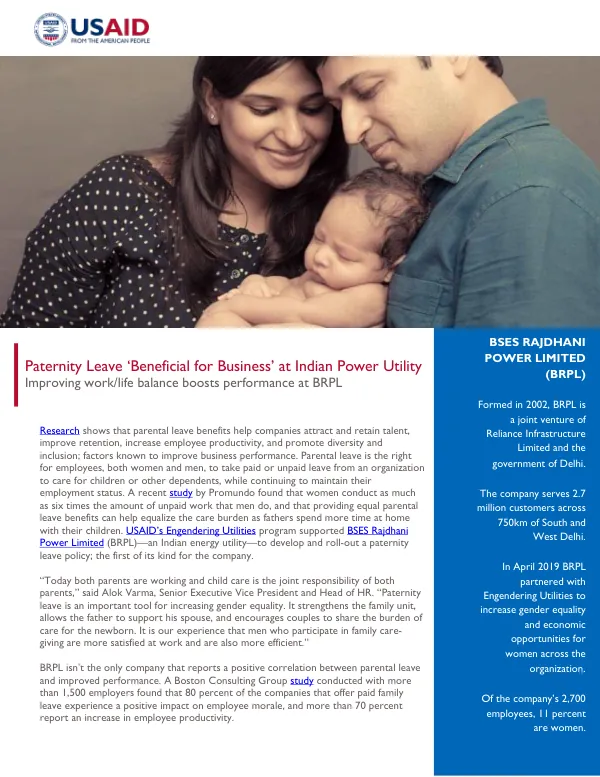
Research by Promundo found that women conduct significantly more unpaid work than men, and providing equal parental leave benefits can help equalize the care burden. USAID's Engendering Utilities program supported BSES Rajdhani Power Limited (BRPL), an Indian energy utility, to develop and roll-out a paternity leave policy, the first of its kind for the company. BRPL's paternity leave policy allows male staff to take a ten-day leave after the birth or adoption of a child. The company's Senior Executive Vice President and Head of HR, Alok Varma, stated that paternity leave is an important tool for increasing gender equality, strengthening the family unit, and allowing fathers to support their spouses. BRPL's experience shows that men who participate in family caregiving are more satisfied at work and more efficient. Studies have found a positive correlation between parental leave and improved performance. A Boston Consulting Group study conducted with over 1,500 employers found that 80% of companies that offer paid family leave experience a positive impact on employee morale, and more than 70% report an increase in employee productivity. BRPL's introduction of paternity leave has been beneficial for the company, with employees reporting increased confidence, motivation, and energy after taking leave. BRPL's paternity leave policy is part of the company's efforts to promote gender equality and reduce bias. The company already had strong paid leave benefits for female employees, but felt that offering paternity leave would benefit its young workforce. Research shows that achieving gender equality and reducing bias requires equal maternity and paternity leave benefits, and BRPL's initial step is a significant leap in the right direction. The company's male staff are more inspired than ever before to take an active role at home, with over 20 male employees using the paternity leave benefit in the last year. BRPL's efforts to combat male stereotypes and stigma associated with childcare responsibilities are building a supportive culture where men feel comfortable taking on more of a family role. The company plans to extend its daycare facilities to male employees, emphasizing the important role that fathers play in sharing caregiving responsibilities with their partners. Engendering Utilities, a program supported by USAID, helps organizations develop a business case for gender equality to persuade senior leadership that equality is good for business. The program provides a framework to implement gender equality interventions, demand-driven change management coaching, and the Gender Equity Executive Leadership Program. Engendering Utilities has supported BRPL in creating the Workplace Equality initiative, encouraging equal participation of male and female employees in trainings, and increasing participation in gender equality initiatives.
Related documents