FUNDACIÓN IDEAS PARA LA PAZ
Peace Councils: Legacy, Challenges and the Last Barricade Around Peace
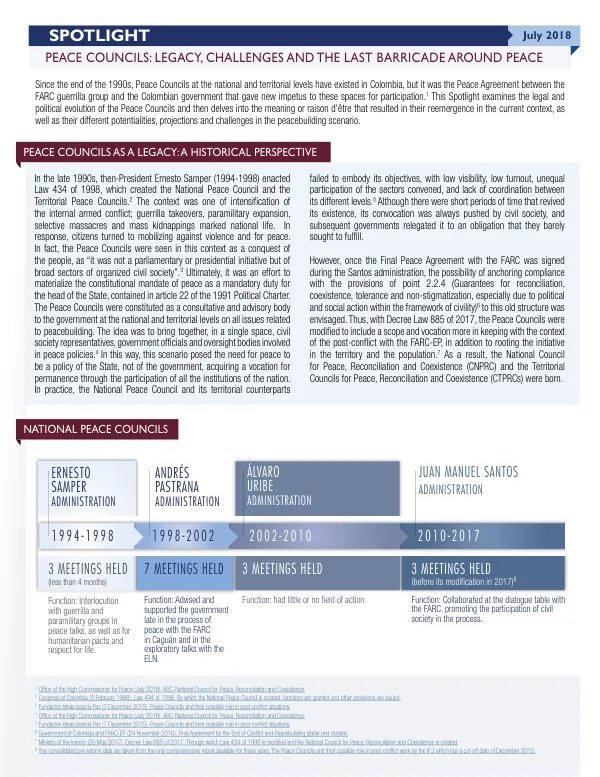
The Peace Councils in Colombia have a long history dating back to the late 1990s, when then-President Ernesto Samper enacted Law 434 of 1998, creating the National Peace Council and the Territorial Peace Councils.
2018 · 3 pages
Sign in to readA free account is required to download.
Abstract
The context at that time was marked by intensification of the internal armed conflict, with guerrilla takeovers, paramilitary expansion, selective massacres, and mass kidnappings. Citizens mobilized against violence and for peace, and the Peace Councils were seen as a conquest of the people, a consultative and advisory body to the government at the national and territorial levels on all issues related to peacebuilding. The Peace Councils were constituted to bring together civil society representatives, government officials, and oversight bodies involved in peace policies. However, in practice, the National Peace Council and its territorial counterparts failed to embody their objectives, with low visibility, low turnout, unequal participation of the sectors convened, and lack of coordination between their different levels. Despite this, the possibility of anchoring compliance with the provisions of the Final Peace Agreement with the FARC to this old structure was envisioned, and with Decree Law 885 of 2017, the Peace Councils were modified to include a scope and vocation more in keeping with the context of the post-conflict with the FARC-EP. The National Council for Peace, Reconciliation, and Coexistence (CNPRC) and the Territorial Councils for Peace, Reconciliation, and Coexistence (CTPRCs) were born, with the aim of creating policies and pacts at the territorial and national levels around peace, reconciliation, coexistence, and non-stigmatization. The Peace Councils should be a space for articulating the different demands, obligations, and agreements that arise from and towards the national government or representatives of civil society, finding connections and shortcomings in the actions aimed at building peace. The CNPRC has 105 representatives, 35 from the institutional level and 70 from civil society, and is composed of three working commissions: Commission on pedagogy, education, communication, art, and culture of peace; Commission on Territorial Peace; and Commission on oversight and guarantees of non-repetition. The National Peace Committee is the executing body of the functions assigned and delegated by the president, composed of 13 representatives. Since their installation on 29 September 2017, the CNPRC has met every three months, in addition to special sessions. The Territorial Peace Councils give priority to the differential and territorial approach in all actions, not only in terms of the broad representativeness and geographical coverage of the Peace Councils, but also because of their differentiated orientation towards vulnerable or discriminated groups such as women, peoples and ethnic communities, peasants, the LGBTI population, children and adolescents, people with disabilities, and political and religious minorities. Departmental Peace Councils are created by ordinance and at the local level by municipal agreement, at the initiative of the Governor and the Mayor, respectively. Municipal Peace Councils exist in 270 municipalities, although there is no consolidated database. The Peace Councils have been linked to social mobilization against political violence and polarization, the definition and development of the platform for civil society participation in negotiations with the ELN, follow-up to the implementation of the Final Peace Agreement, and the promotion of the chair of political culture for reconciliation and coexistence, linked to the pre-existing chair of peace. The Peace Councils are a space for articulating the different demands, obligations, and agreements that arise from and towards the national government or representatives of civil society, finding connections and shortcomings in the actions aimed at building peace.
Related documents