USAID DEC
Pediatric HIV in Mozambique: Results from an Application of the Pediatric HIV Transition Model
Sign inHEALTH POLICY PLUS
Pediatric HIV in Mozambique: Results from an Application of the Pediatric HIV Transition Model
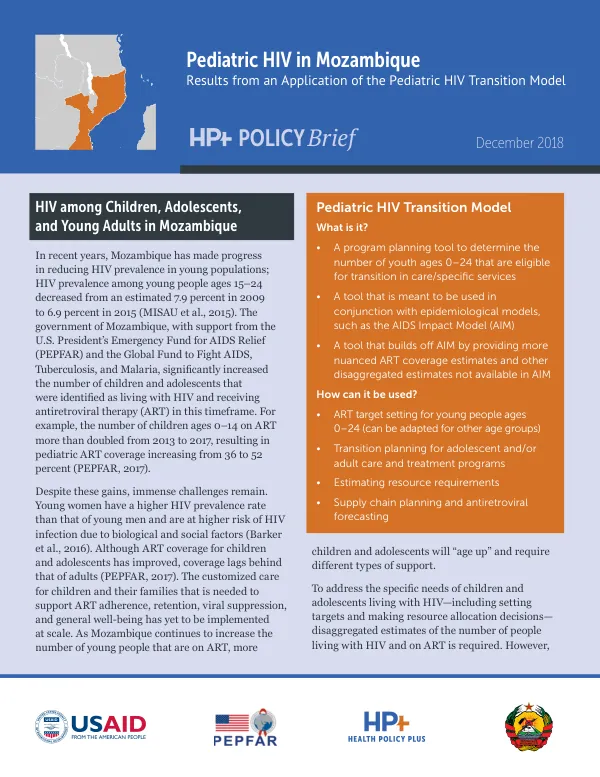
The Pediatric HIV Transition Model was applied to project the number of children, adolescents, and young adults ages 0-24 living with HIV on antiretroviral therapy (ART) in Mozambique from 2018 to 2025.
2018 · 6 pages
Sign in to readA free account is required to download.
Abstract
The model used official, country-specific AIDS Impact Model (AIM) files to estimate the number of people living with HIV ages 0-24. Program targets and programmatic data on HIV testing coverage, yield rates, rates of linkage to care, and retention rates were used to estimate the number of people ages 0-24 on ART each year. The model was applied to two scenarios: a trends scenario, which assumes increases in coverage based on past trends in identification, linkage to care, and retention in care, and a target scenario, which assumes increases in coverage in line with meeting global HIV targets. Under the trends scenario, the number of people ages 0-24 on ART is estimated to increase from 185,275 in 2018 to 288,967 in 2025. The results suggest that Mozambique will fall short of meeting its targets of ART coverage by 33,904 people, or 11 percent, by 2025. Under the target scenario, the number of people ages 0-24 on ART is projected to increase from 256,774 in 2018 to 322,871 in 2025. Over half of youth ages 0-24 on ART are projected to be female (57-59 percent, depending on the year) in this scenario. Youth between the ages of 20 and 24 represent the largest proportion of 0-24-year-olds on ART (40-45 percent, depending on the year). The province of Zambezia has the highest number of youth ages 0-24 on ART in this scenario. The Pediatric HIV Transition Model also estimated the number of girls and young women ages 15-24 who will be eligible to participate in Servicios Amigos dos Adolescentes (SAAJ) clinics. The model assumed that girls and young women who have at least two children or are pregnant with their second child are usually ineligible to participate in SAAJ clinics. The proportion of adolescents age 18 years and younger who fall into this category is small (range: 0.3 percent for 15-year-olds to 12.1 percent for 18-year-olds, nationally). However, the proportion of older adolescents and young women with at least two children or who are pregnant with their second child is much higher; for example, two-thirds of 24-year-olds fall into this group. The results of the Pediatric HIV Transition Model suggest that Mozambique will face significant challenges in meeting its targets of ART coverage for children, adolescents, and young adults ages 0-24. The model highlights the need for increased efforts to identify, link, and retain people living with HIV in care, particularly in provinces with high HIV prevalence and incidence. The model also emphasizes the importance of providing targeted services to adolescent girls and young women, particularly those who are pregnant or have multiple children. The Pediatric HIV Transition Model was developed by the Health Policy Plus (HP+) project, which is funded by the U.S. Agency for International Development (USAID) and the President's Emergency Plan for AIDS Relief (PEPFAR). The model is a program planning tool that can be used to determine the number of youth ages 0-24 that are eligible for transition in care and specific services. The model can also be used to estimate resource requirements, supply chain planning, and antiretroviral forecasting. The results of the Pediatric HIV Transition Model have important implications for HIV programming in Mozambique. The model highlights the need for increased efforts to identify, link, and retain people living with HIV in care, particularly in provinces with high HIV prevalence and incidence. The model also emphasizes the importance of providing targeted services to adolescent girls and young women, particularly those who are pregnant or have multiple children.
Related documents