INTRAHEALTH
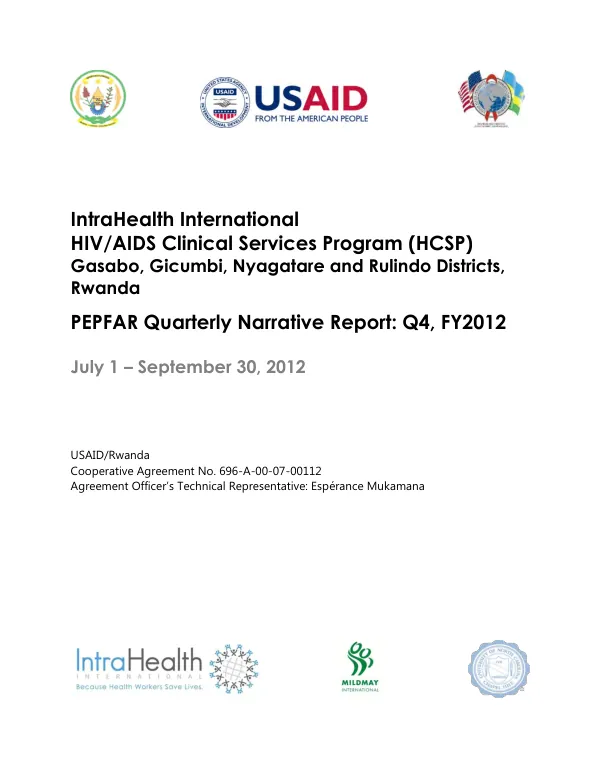
PEPFAR Quarterly Narrative Report: Q4, FY2012
The HIV/AIDS Clinical Services Program (HCSP) in Rwanda is a five-year initiative funded by the United States Agency for International Development (USAID) with a total budget of $29.4 million.
2012 · 30 pages
Sign in to readA free account is required to download.
Abstract
The program aims to reinforce Rwanda's healthcare system and expand access to HIV and AIDS clinical services in the districts of Gasabo, Gicumbi, Nyagatare, and Rulindo. IntraHealth International implements the program in partnership with the Rwanda Biomedical Center, the Institute of HIV/AIDS, Disease Prevention and Control, district health units, and other key stakeholders. During the period of July-September 2012, the HCSP supported 93 subgrants designed to support health centers, hospitals, and district health units in achieving district and national objectives. These subgrants included 50 service delivery input subgrants and 43 performance-based financing (PBF) fixed obligation grants. The program's focus areas include palliative care, service integration, reproductive health, family planning, maternal and child health, nutrition, and gender, particularly services associated with gender-based violence. The HCSP collaborates directly with the sites it supports to plan, implement, monitor, and evaluate their activities. Technical and management staff participate in several technical working groups of the Rwandan Ministry of Health, including the TWGs for HIV prevention, HIV care and treatment, tuberculosis/HIV integration, family planning, maternal and child health, nutrition, gender and gender-based violence, performance-based financing, laboratory, community health, monitoring and evaluation, and strategic information. This participation provides a forum for the HCSP to share lessons learned and learn from others, enhancing its partnership with the Ministry of Health and aligning its work with Rwandan priorities. The program's performance-based financing (PBF) component is a key aspect of its implementation. PBF is a financing mechanism that rewards healthcare providers for achieving specific health outcomes. In the context of the HCSP, PBF is used to incentivize healthcare providers to deliver high-quality HIV and AIDS clinical services. The program's PBF component is designed to improve the quality and efficiency of healthcare services, ultimately leading to better health outcomes for patients. The HCSP's focus on palliative care is another critical aspect of its implementation. Palliative care is a type of care that focuses on providing relief from the symptoms and stress of a serious illness. In the context of HIV and AIDS, palliative care is essential for improving the quality of life for patients living with the disease. The HCSP's commitment to palliative care is reflected in its participation in the Technical Working Group for Non-Communicable Disease, which includes a palliative care sub-group. Overall, the HCSP's implementation in Rwanda is a critical component of the country's efforts to combat the HIV and AIDS epidemic. The program's focus on palliative care, service integration, and performance-based financing is designed to improve the quality and efficiency of healthcare services, ultimately leading to better health outcomes for patients.
Related documents