GIZ
Perceptions of International Assistance Actors: Summary of Findings
The Iraq Community Resilience Initiative (ICRI-Ta'afi) aims to increase stability in Iraq by creating conditions for durable returns in areas recovering from the destruction caused by the so-called Islamic State of Iraq and Syria (ISIS).
2020 · 22 pages
Sign in to readA free account is required to download.
Abstract
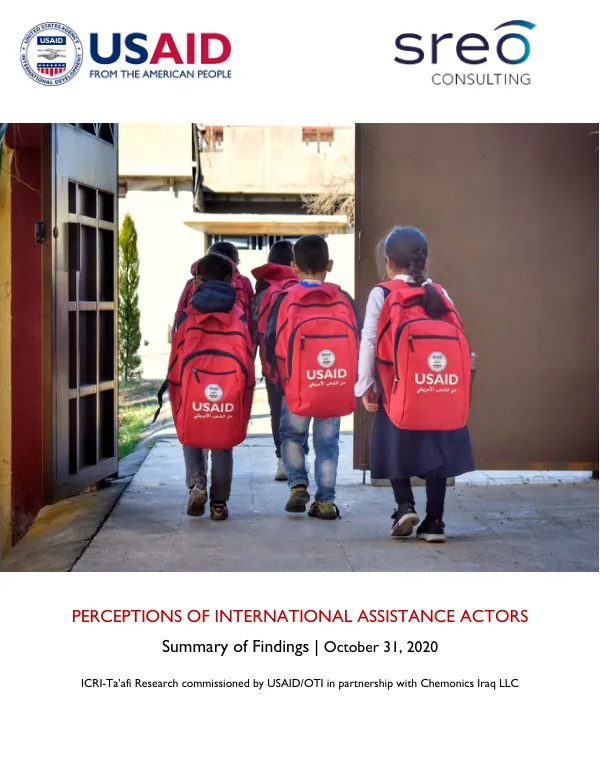
Funded by USAID's Office of Transition Initiatives (OTI) and implemented by Chemonics, the program works with a variety of partners to implement small grants, including civil society organizations, youth and volunteer groups, faith-based organizations, and local governance entities. As of October 31, ICRI-Ta'afi has implemented 227 activities since June 2018 and has a total budget of $86.3 million obligated. A study commissioned by USAID/OTI in partnership with Chemonics Iraq LLC aimed to understand whether communities associate the USAID logo with assistance from the U.S. government. The study also sought to gauge how people feel about the presence of USAID programming and its impact on their willingness to remain in their current location. Additionally, the study aimed to determine whether being associated with USAID affects the credibility of project grantees in the eyes of local communities and whether explicit USAID branding has any impact on their own safety. The study collected data through surveys and key informant interviews in four districts: al-Qaim, Mosul, the Ninewa Plain, and Sinjar. The first round of data collection took place from February 25 to March 7, 2020, and included 1,606 surveys. The second round took place from August 30 to September 29, 2020, and included 227 surveys and 74 key informant interviews. The study found that logo recognition rates paralleled the perceived presence of assistance providers in each district. USAID was only widely recognized in the Ninewa Plain, where it is perceived to be a large assistance provider. The study also found that logo recognition does not correlate with education levels. In the Ninewa Plain, where education levels are high, most logos were widely recognized. In contrast, in al-Qaim, where education levels are also high, recognition of logos was decidedly mixed. In Sinjar, where education levels are low, some logos were widely recognized, including the U.S. flag, the German development agency (GIZ), and the International Organization for Migration (IOM). In Mosul, where education levels are low, there was overall low recognition of many logos. Regarding public perceptions of selected foreign assistance actors, the organizations included in the study – USAID, GIZ, and the United Nations Development Programme (UNDP) – are viewed most positively in Sinjar, followed by Mosul. Only around 60-65% of people viewed these institutions positively in al-Qaim, while the Ninewa Plain scored lowest, with only 55-65% of people viewing them positively. USAID is most recognized in the district with the lowest perceptions of international assistance providers. Most respondents across all locations said they felt safer knowing USAID operates in their area, although the same was true for the other organizations included in the study. USAID's assistance mostly elicits positive feelings for improving livelihoods, fostering job creation, and supporting infrastructure rehabilitation. Overall, data has shown that feelings of safety and intentions of migration do not seem to be related to USAID's presence specifically but rather to the presence of non-governmental organizations (NGOs) and international assistance actors in general. Perceptions of corruption among groups receiving foreign funding varied across districts. In Sinjar, people mostly felt that local organizations receiving international assistance were less corrupt. In Mosul and the Ninewa Plain, people considered local organizations more corrupt if they receive foreign funding. In al-Qaim, most people said foreign funding did not impact their views on perceived corruption of NGOs one way or the other. Some respondents lamented the need for foreign assistance given Iraq's wealth of natural resources.
Related documents