USAID DEC
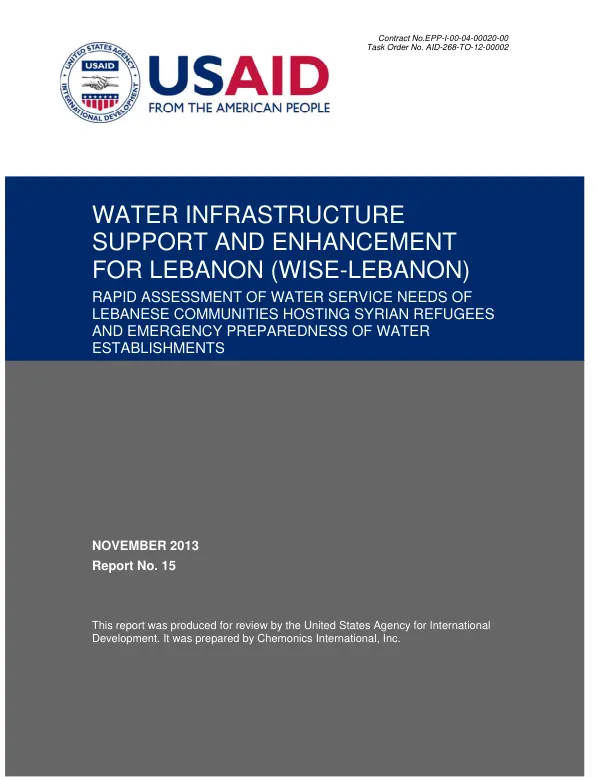
WISE-Lebanon Rapid Assessment Report: Rapid Assessment of Water Service Needs of Lebanese Communities Hosting Syrian Refugees and Emergency Preparedness of Water Establishments
Sign inCHEMONICS
WISE-Lebanon Rapid Assessment Report: Rapid Assessment of Water Service Needs of Lebanese Communities Hosting Syrian Refugees and Emergency Preparedness of Water Establishments
The WISE-Lebanon Rapid Assessment Report was conducted in August 2013 at the request of USAID to assess the communities served by the Water Establishments (WE) in Lebanon, which were directly affected by the Syrian refugee influx.
2013 · 57 pages
Sign in to readA free account is required to download.
Abstract
The assessment aimed to identify, develop, and recommend integrated interventions to raise the capacity of the WEs to cope with the increase in water demands on local water resources due to the refugee influx and to address recurring emergencies. The assessment was implemented in two parts: a quick response needs assessment in the water sector to identify potential interventions that could be implemented within six months to one year, and an emergency preparedness assessment of the WEs' ability to respond to emergency and crisis situations that affect service delivery. The assessment team coordinated with the WE senior management, municipalities, and the current efforts of other donors in response to the crisis. The recommended quick response activities were identified through a consultation process with the WE Director Generals and their senior staff, as well as meetings with the WE branch managers and municipal officials. The assessment team developed matrices to list the potential quick response interventions using discrete selection criteria, which prioritized the types of various interventions proposed by the WEs. The team directed the WEs' senior management to focus on capital repair and replacement interventions that could be implemented in a relatively quick manner. The assessment team documented both existing needs before the Syrian refugee crisis as well as direct impacts as a result of the crisis. Generally, there is an average of 50% service coverage within the assessed WEs, and overall performance is poor. The team reviewed key performance indicators from the WE business plans to benchmark pre-crisis conditions, such as service coverage, percentage of non-revenue water (NRW), and collection rate percentage. The assessment of the WEs confirmed that many of the pre-crisis needs have become more urgent. The assessment team observed an increasing reliance on alternative systems for domestic water supply due to the increase in water demands. However, one of the most common existing needs of the WEs is continuous electricity. Nearly all of the service areas of the WEs are experiencing electrical supply intermittency, which contributes to water supply intermittency. The assessment team emphasized the timeline of implementation and impact of host communities by percentage of Syrian refugees, although cost estimates were not considered as criteria for prioritization. The assessment team cooperated with donors such as UNHCR, UNICEF, UNDP, ICRC, GIZ, the World Bank, and the European Union to capitalize on their response activities and lessons learned to date, and leveraged their successes to further the objectives of the rapid assessment recommendations. The assessment team directed the WEs' senior management to focus on capital repair and replacement interventions that could be implemented in a relatively quick manner, with major capital investment projects receiving lower ratings in the prioritization process.
Related documents