MANAGEMENT SYSTEMS INTERNATIONAL
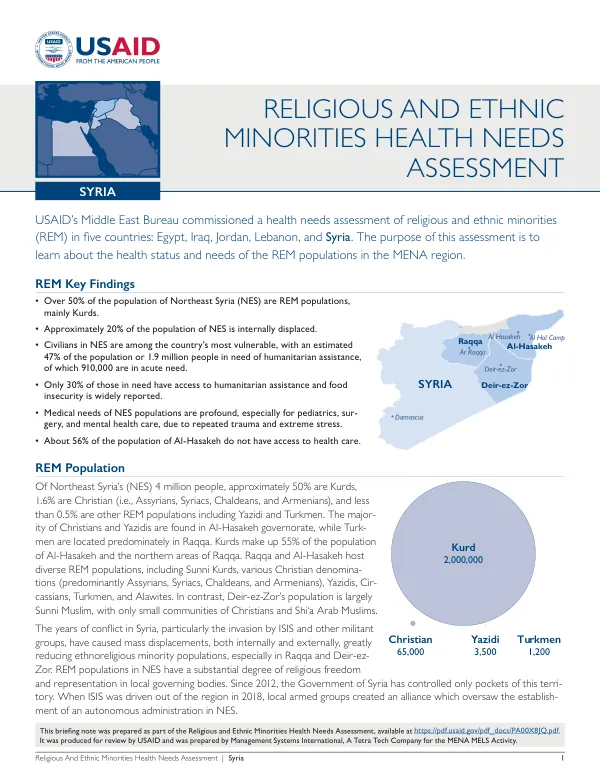
Religious and Ethnic Minorities Health Needs Assessment Briefing Note: Iraq
The Religious and Ethnic Minorities Health Needs Assessment in Iraq highlights the significant health challenges faced by religious and ethnic minority (REM) populations in the country.
2021 · 3 pages
Sign in to readA free account is required to download.
Abstract
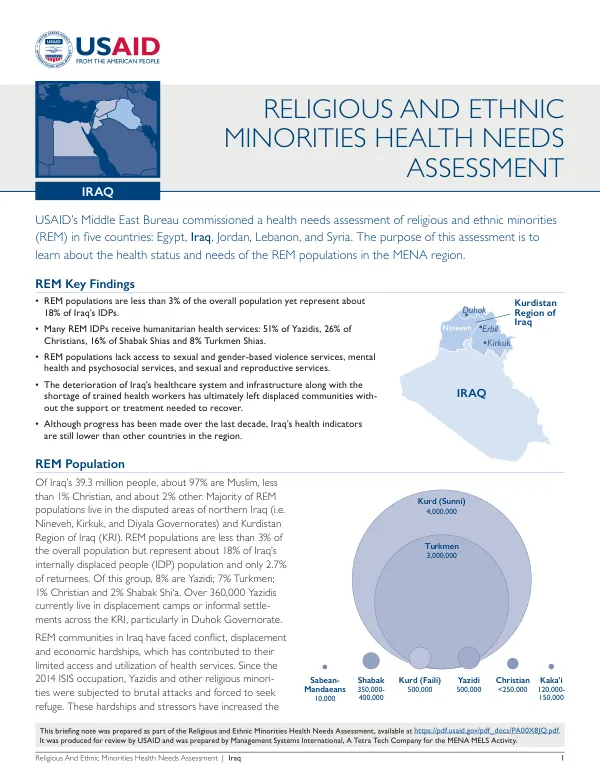
These populations are disproportionately affected by conflict, displacement, and economic hardships, resulting in limited access to health services. REM populations in Iraq are estimated to be less than 3% of the overall population, yet they represent about 18% of the country's internally displaced people (IDPs). Many REM IDPs receive humanitarian health services, with 51% of Yazidis, 26% of Christians, 16% of Shabak Shias, and 8% of Turkmen Shias currently receiving these services. However, REM populations lack access to essential health services, including sexual and gender-based violence services, mental health and psychosocial services, and sexual and reproductive services. The assessment reveals that Iraq's healthcare system is severely underdeveloped, with a shortage of medical personnel, particularly doctors and nurses. The country has a reported 7.4 physicians per 10,000 people and 21 nurses and midwives per 10,000 people. Many health facilities are abandoned, destroyed, or damaged, and only half of health facilities in Nineveh are fully operational. The mental health system is also severely lacking, with limited capacity and services available. The COVID-19 pandemic has exacerbated the health challenges faced by REM populations in Iraq. A rapid assessment conducted in March 2020 showed a 65% increase in reported cases of gender-based violence (GBV) during the outbreak, with 94% of incidents being domestic violence perpetrated by a household member. The assessment also reported a 40% increase in GBV survivors coming in for help since March. Key health indicators in Iraq are lower than other countries in the region, with a maternal mortality ratio higher than Syria, Lebanon, Jordan, and Egypt. The maternal-related female deaths are also alarming, with 41% of those women being under 24 years old. Neonatal mortality under age five is also high, with 40% due to respiratory causes related to the perinatal period. One out of every ten children under-five is chronically malnourished in Iraq, with prevalence of underweight, stunting, and wasting being higher in Nineveh compared to the Kurdistan Region of Iraq (KRI) or Iraq overall. The assessment highlights the need for improved health services, particularly for REM populations, and emphasizes the importance of addressing the root causes of health challenges, including conflict, displacement, and economic hardships. It also underscores the need for increased funding and investment in the healthcare system, as well as the development of mental health and psychosocial support services. The estimated number of IDPs and returnees in Iraq is significant, with over 1.39 million IDPs and 4.6 million returnees. The majority of IDPs and returnees are in Nineveh Governorate or the Kurdistan Region of Iraq (KRI). The most severe health needs are in governorates that witnessed direct conflict, such as Al-Anbar, Nineveh, Kirkuk, and Salah Al-Din, and in areas that received large numbers of the displaced, such as Duhok. The health system challenges in Iraq are multifaceted, including a lack of health workforce, health facilities, and mental health services. The country has a shortage of medical personnel, particularly doctors and nurses, and many health facilities are abandoned, destroyed, or damaged. The mental health system is also severely lacking, with limited capacity and services available. The humanitarian health services in Iraq are largely funded by international NGOs and donors, but the 2020 budget was reportedly reduced, and funds for responding to COVID-19 effects are uncertain. The primary healthcare services for IDPs are largely funded by international NGOs and donors, but the 2020 budget was reportedly reduced, and funds for responding to COVID-19 effects are uncertain.
Related documents