USAID DEC
Performance Evaluation of the Rule of Law Stabilization - Informal Component Program
Sign inUSAID DEC
Performance Evaluation of the Rule of Law Stabilization - Informal Component Program
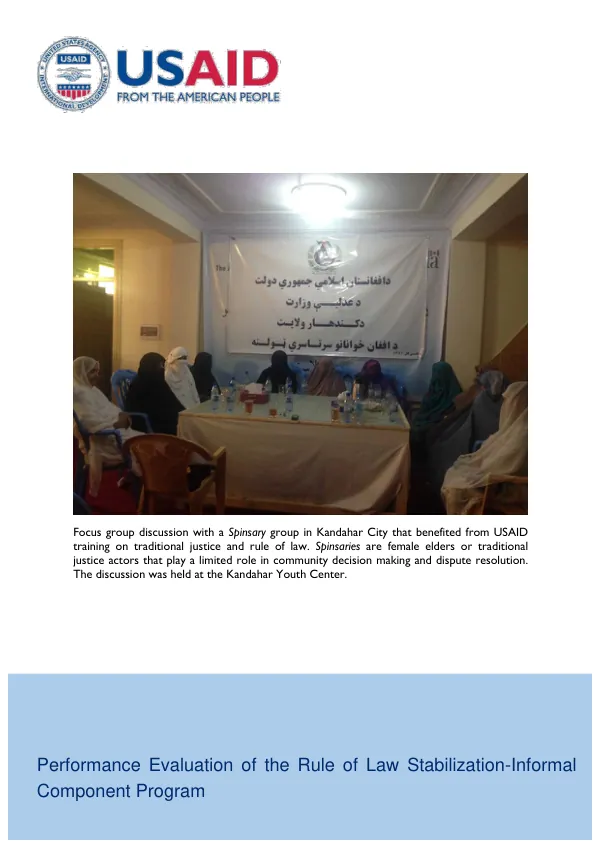
The Rule of Law Stabilization-Informal Component Program was implemented in Afghanistan to promote traditional dispute resolution (TDR) and strengthen linkages between formal and informal justice systems.
2014 · 91 pages
Sign in to readA free account is required to download.
Abstract
The program was launched in 2012 with funding from the United States Agency for International Development (USAID). The primary objective of the program was to improve access to justice for rural communities, particularly women and marginalized groups. Initial assessments conducted in 2012 identified a need for TDR training and capacity building among local justice actors. The program focused on training TDR actors in Islamic and Afghan law, as well as providing them with skills to resolve disputes in a fair and transparent manner. Community cultural centers (CCCs) were also established to provide a platform for TDR actors to share their experiences and best practices. The program's effectiveness was evaluated through a performance evaluation conducted in May 2014. The evaluation involved a desk review of program documents, key informant interviews, focus group discussions, and a quantitative survey of 600 indirect beneficiaries. The evaluation aimed to assess the program's impact on TDR actors' knowledge and skills, as well as its contribution to the reduction of harmful social practices and improved linkages between formal and informal justice systems. Key findings from the evaluation revealed that TDR actors' knowledge of Islamic and Afghan law improved significantly after receiving training. The evaluation also found that the program contributed to a reduction in violations of women's rights in the local area, with a notable decrease in the frequency of baad (a traditional practice of exchanging women as a form of compensation for a crime). Additionally, the program led to an increase in female participation in dispute resolution, with 71% of survey respondents reporting that women were more involved in TDR processes. The evaluation also assessed the program's impact on the resolution of long-standing disputes. Results showed that 63% of survey respondents perceived an improvement in the resolution of such disputes, with 45% reporting that TDR actors were more effective in resolving disputes than formal justice providers. Furthermore, the evaluation found that the program strengthened linkages between formal and informal justice systems, with 71% of survey respondents reporting that they would seek justice from TDR actors on disputes related to land, family, and criminal violations. Based on the evaluation findings, the report provides recommendations for future program implementation. These include providing ongoing training and capacity building for TDR actors, expanding the program's reach to more rural communities, and strengthening linkages between formal and informal justice systems. The report also emphasizes the importance of continued support for CCCs and the development of guidelines for focus group discussions and key informant interviews.