USAID
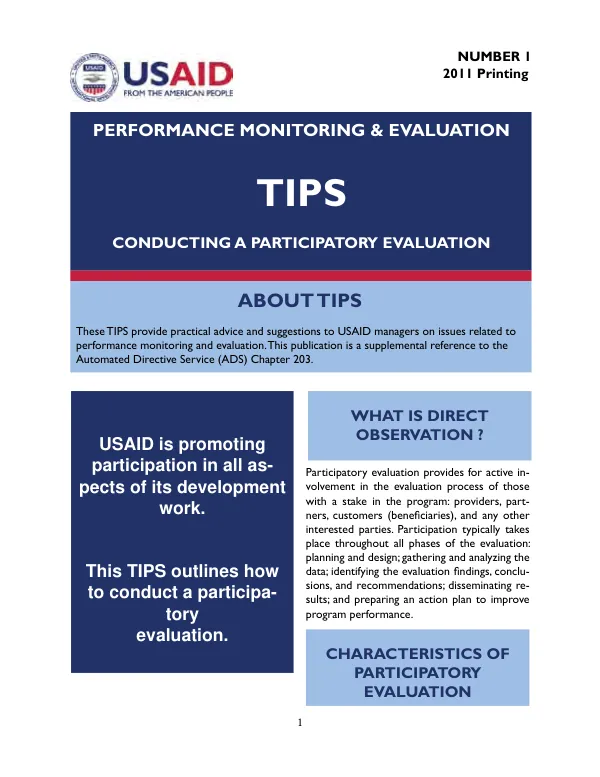
Performance Monitoring & Evaluation TIPS: Conducting a Participatory Evaluation
Participatory evaluation is a collaborative approach to assessing program performance that involves active involvement of stakeholders, including providers, partners, customers, and other interested parties.
2011 · 6 pages
Sign in to readA free account is required to download.
Abstract
This approach is promoted by USAID as a means of improving program performance by listening to and learning from program beneficiaries, field staff, and other stakeholders. Participatory evaluations share several characteristics that distinguish them from traditional evaluation approaches. These include participant focus and ownership, scope of participation, participant negotiations, diversity of views, learning process, flexible design, empirical orientation, and use of facilitators. The approach emphasizes the importance of involving stakeholders in all phases of the evaluation, from planning and design to data collection, analysis, and dissemination of results. Experience has shown that participatory evaluations can improve program performance by empowering program providers and beneficiaries to act on the knowledge gained. The advantages of participatory evaluations include examining relevant issues by involving key players in evaluation design, promoting participants' learning about the program and its performance, improving participants' evaluation skills, mobilizing stakeholders, enhancing teamwork, and building shared commitment to act on evaluation recommendations. However, participatory evaluations may also have disadvantages, such as being viewed as less objective due to the involvement of stakeholders with possible vested interests, being less useful in addressing highly technical aspects, requiring considerable time and resources to identify and involve a wide array of stakeholders, taking participating staff away from ongoing activities, and being dominated and misused by some stakeholders to further their own interests. The steps in conducting a participatory evaluation include deciding if a participatory evaluation approach is appropriate, deciding on the degree of participation, preparing the evaluation scope of work, conducting the team planning meeting, conducting the evaluation, analyzing the data and building consensus on results, and preparing an action plan to improve program performance. Participatory evaluations typically use rapid appraisal techniques, which are simpler, quicker, and less costly than conventional sample surveys. These techniques include methods such as key informant interviews, focus groups, and observation. The facilitators play a crucial role in guiding participants in the use of these methods and helping them to reach consensus on findings, conclusions, and recommendations. In contrast to traditional evaluations, participatory evaluations focus on learning, involve a broad range of stakeholders, and use flexible design and rapid appraisal methods. The facilitators in participatory evaluations serve as supporters and guides, rather than evaluators, and the approach emphasizes the importance of building a common body of knowledge among stakeholders.