USAID DEC
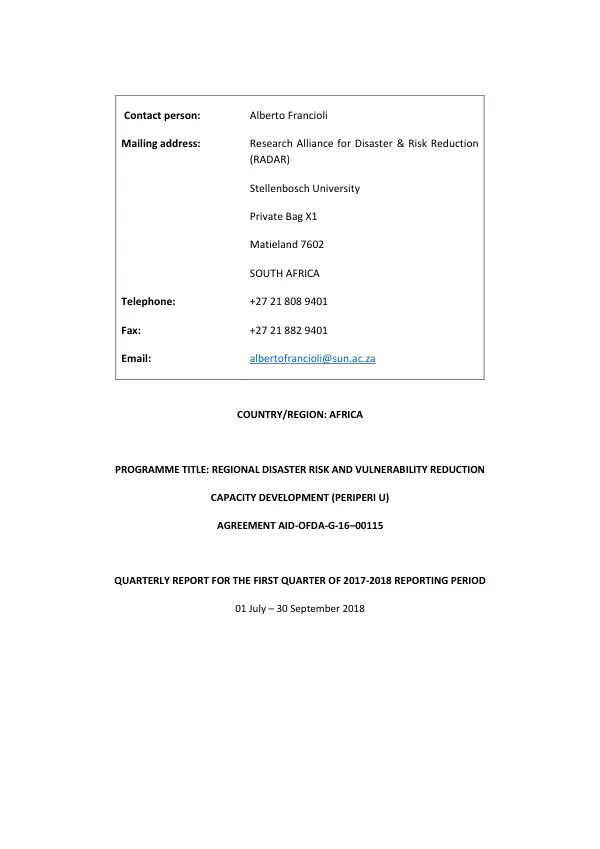
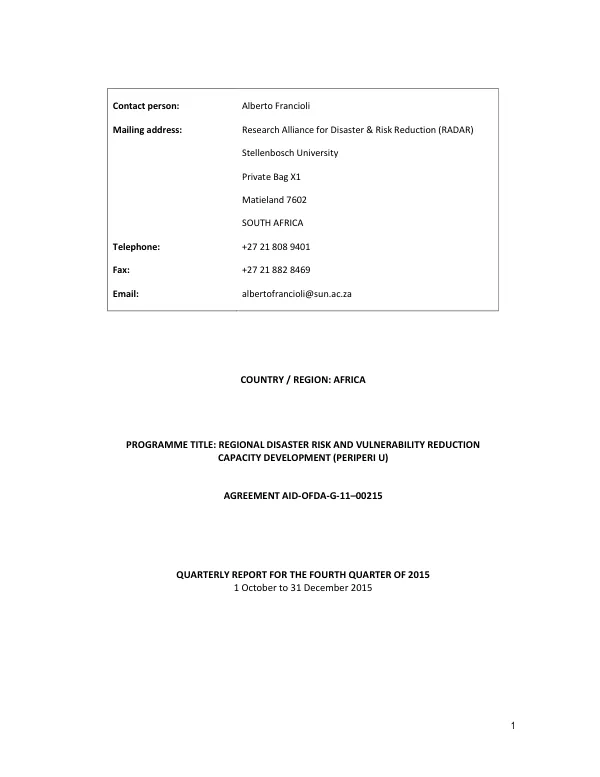
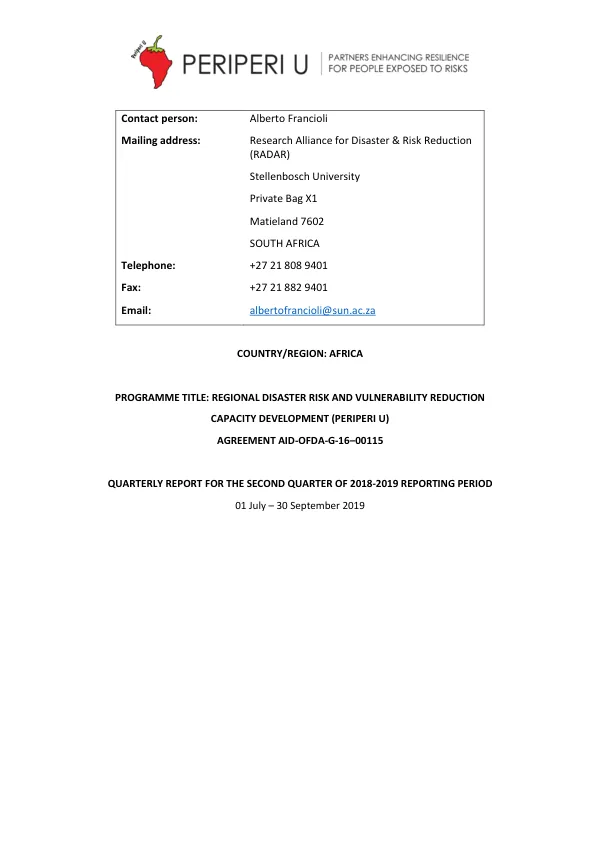
Periperi U Quarterly Report 01 July – 30 September 2019: Regional Disaster Risk and Vulnerability Reduction Capacity Development (Periperi U)
Sign inUSAID DEC
Periperi U Quarterly Report 01 July – 30 September 2019: Regional Disaster Risk and Vulnerability Reduction Capacity Development (Periperi U)
The Periperi U Consortium of Universities is a collaborative effort among higher education institutions in Africa to enhance disaster risk reduction (DRR) and management (DRM) capacity.
2019 · 25 pages
Sign in to readA free account is required to download.
Abstract
The consortium is comprised of 11 universities from 11 countries, including Ahmadu Bello University, Nigeria; ARU University, Tanzania; Bahir Dar University, Ethiopia; Gaston Berger University, Senegal; Makerere University, Uganda; Moi University, Kenya; Stellenbosch University, South Africa; University of Antananarivo, Madagascar; University of Buea, Cameroon; Universidade Técnica de Moçambique, Moçambique; and University of Ghana, Ghana. The Periperi U program is funded by the United States Agency for International Development (USAID) under Agreement AID-OFDA-G-16-00115. The program's primary objective is to enhance the capacity of higher education institutions in Africa to contribute to DRR and DRM efforts. The program's scope includes eight key focus areas, which are categorized into two sub-sectors: Global advocacy and engagement in DRR, and Integration/Enhancement of DRR within Education and Research Programmes. The Global advocacy and engagement in DRR sub-sector focuses on promoting the role of higher education institutions in DRR and DRM efforts. This includes strategic advocacy to define higher education as a crucial player in DRR education, capacity building, and research. The sub-sector also aims to identify and mobilize funding mechanisms for developing country higher education institutions to advance DRR education and research. The Integration/Enhancement of DRR within Education and Research Programmes sub-sector focuses on integrating DRR into existing education and research programs. This includes institutional effectiveness, maturation, and sustainability of the Periperi U partnership, as well as strategic scaling-up of DRM/DRR educational activities across Africa. The sub-sector also aims to institutionalize active DRR scholarship in each partner institution, including sustainability of staffing and financing. The Periperi U Consortium has made significant progress in the second quarter of the 2018-2019 reporting period. The consortium has established a strong partnership among its member institutions, with a focus on institutional effectiveness, maturation, and sustainability. The consortium has also made progress in promoting disaster risk-related education and research as legitimate domains in contemporary scholarship in Africa. In terms of specific activities, the consortium has conducted a range of activities, including academic programs, short courses, risk research, and community outreach. The consortium has also engaged in strategic and technical engagements to advance robust DRM policy. The consortium has also established online platforms to facilitate collaboration and knowledge sharing among its member institutions. The Periperi U Consortium has reported several highlights and plans going forward. The consortium has achieved significant progress in its first year of operation, with a focus on institutional effectiveness, maturation, and sustainability. The consortium has also made progress in promoting disaster risk-related education and research as legitimate domains in contemporary scholarship in Africa. The consortium has also reported several challenges and obstacles, including limited funding and resources. However, the consortium has developed a range of strategies to address these challenges, including seeking additional funding and resources, and leveraging partnerships with other organizations to support its activities. In conclusion, the Periperi U Consortium of Universities has made significant progress in its efforts to enhance disaster risk reduction and management capacity in Africa. The consortium has established a strong partnership among its member institutions, with a focus on institutional effectiveness, maturation, and sustainability. The consortium has also made progress in promoting disaster risk-related education and research as legitimate domains in contemporary scholarship in Africa.