USAID DEC
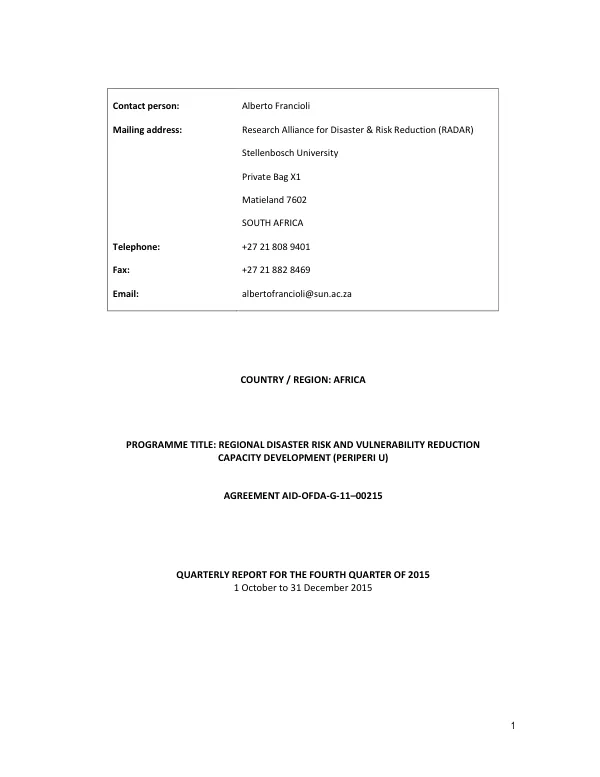
Regional Disaster Risk and Vulnerability Reduction Capacity Development (Periperi U) Quarterly Report for the Fourth Quarter of 2015
Sign inBAHIR DAR UNIVERSITY
Regional Disaster Risk and Vulnerability Reduction Capacity Development (Periperi U) Quarterly Report for the Fourth Quarter of 2015
The Periperi U Consortium of universities in Africa made significant progress in the fourth quarter of 2015, covering 1 October to 31 December.
2015 · 22 pages
Sign in to readA free account is required to download.
Abstract
The consortium's progress is described in terms of the five key focus areas of the Periperi U programme. Institutional development, embedding, and expansion of disaster risk-related teaching and training, research, and policy advocacy capacity were key objectives. Partners implemented various activities to achieve this goal, including the development of new undergraduate and graduate programmes, the provision of short disaster risk-related courses, and the generation and communication of applied research outputs. The provision of short disaster risk-related courses was a major focus area during this period. Eight short courses were implemented by four partners, reaching 148 participants, with more than one-third being women. Makerere University implemented two health-related short courses, while the University of Stellenbosch conducted a Community Risk Assessment short course. Tanà University's short course on disaster risk management was implemented sub-regionally in Madagascar, reaching 96 people. The growth and sustainability of new undergraduate and graduate programmes related to reducing and managing disaster risk and vulnerability were also a key focus area. Twelve disaster risk-related academic programmes and eight modules were implemented during this period, with 1,086 students participating. Successful efforts at integrating disaster risk concerns into broader academic programmes were particularly notable, with Tanà University offering a disaster risk-related economics module to students enrolled in three different undergraduate programmes. The generation and communication of applied research outputs by each unit/programme were also a key focus area. Partners implemented various activities to achieve this goal, including the development of new research outputs and the communication of existing research outputs to stakeholders. The consortium's secretariat played a key role in facilitating and coordinating these activities. The mobilisation of the consortium to advance disaster-risk reduction efforts through strategic engagements at national, sub-national, continental, and international scales was also a key focus area. Partners implemented various activities to achieve this goal, including the development of new partnerships and the participation in international conferences and workshops. The consortium's progress was monitored and evaluated through various means, including the use of tables and figures to track progress and outcomes. The appendices to this report provide further details on the consortium's progress, including staff composition, short courses implemented, and research outputs generated. Overall, the Periperi U Consortium made significant progress in the fourth quarter of 2015, achieving key objectives in institutional development, the provision of short disaster risk-related courses, the growth and sustainability of new undergraduate and graduate programmes, the generation and communication of applied research outputs, and the mobilisation of the consortium to advance disaster-risk reduction efforts.
Related documents