RTI INTERNATIONAL
Philippines Remote Learning Study (Brief #3): Use of Technology
The Philippines Remote Learning Study was conducted during the 2020-2021 school year to investigate how mother-tongue-based multilingual education reading instruction proceeded in 20 schools around the country while classrooms were closed.
2021 · 3 pages
Sign in to readA free account is required to download.
Abstract
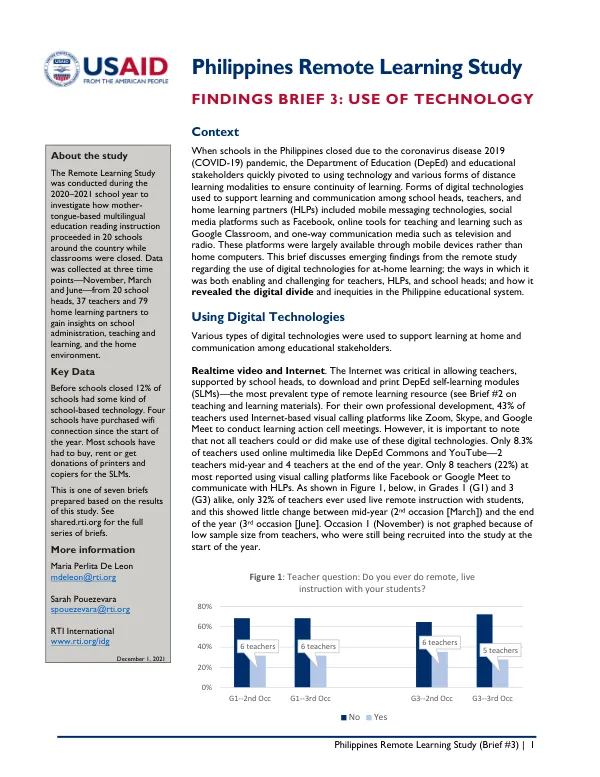
Data was collected at three time points—November, March, and June—from 20 school heads, 37 teachers, and 79 home learning partners to gain insights on school administration, teaching and learning, and the home environment. Before schools closed, 12% of schools had some kind of school-based technology. Four schools purchased wifi connections since the start of the year, and most schools had to buy, rent, or get donations of printers and copiers for the self-learning modules (SLMs). The study found that various types of digital technologies were used to support learning at home and communication among educational stakeholders. Real-time video and internet were critical in allowing teachers, supported by school heads, to download and print DepEd self-learning modules. For their own professional development, 43% of teachers used internet-based visual calling platforms like Zoom, Skype, and Google Meet to conduct learning action cell meetings. However, not all teachers could or did make use of these digital technologies. Only 8.3% of teachers used online multimedia like DepEd Commons and YouTube, and only 8 teachers (22%) at most reported using visual calling platforms like Facebook or Google Meet to communicate with home learning partners. Messaging apps were also widely used, with 56% of teachers surveyed saying they used short message service (SMS) to communicate with home learning partners. Social media platforms like Facebook and Messenger were reported most often by teachers and home learning partners, possibly because they were zero-rated in the Philippines. School heads also used a variety of modalities to communicate with teachers and home learning partners, including video calling platforms like Zoom, Facebook, Skype, and Google Meet. Broadcast technology was also used, with 13 teachers using radio broadcasts and 3 teachers using television broadcasts. Parents from 6 different schools mentioned use of DepEd TV during interviews, and teachers from 4 schools out of 20 also mentioned its use. However, very few teachers aligned students' lessons to television and radio broadcasts, and instead encouraged students to watch selected episodes and tune in to scheduled lessons for their grade level. Teachers who could use technology found creative ways of doing so, such as conducting one-on-one oral reading lessons using video calls or voice calls, or having parents submit video recordings of students for teachers to review. A common concern of teachers was the uncertainty of whether students were really learning and answering the modules themselves.