RTI INTERNATIONAL
USAID STRIDE Annual Report 2019
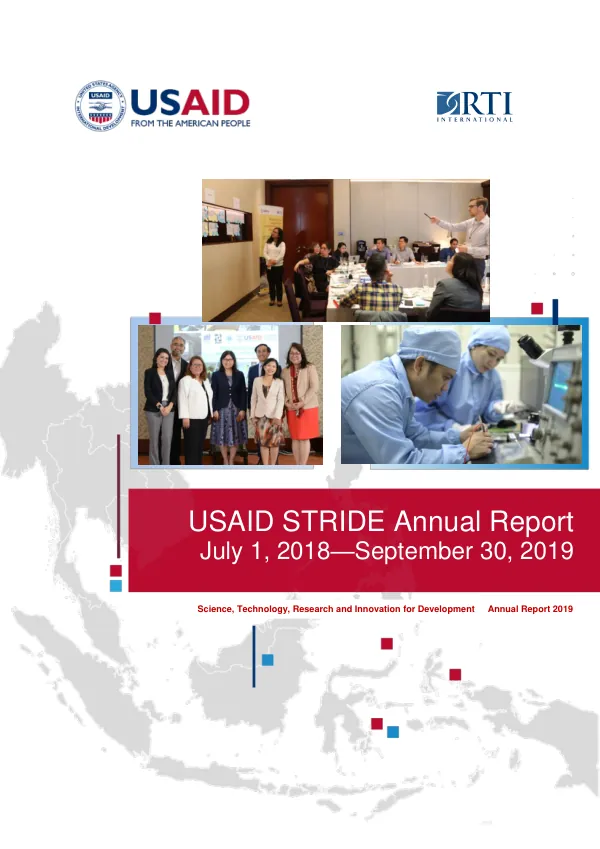
The Science, Technology, Research and Innovation for Development (STRIDE) initiative in the Philippines aimed to enhance the country's capacity for science, technology, research, and innovation.
2019 · 73 pages
Sign in to readA free account is required to download.
Abstract
The program was implemented from July 1, 2018, to September 30, 2019, with funding from the United States Agency for International Development (USAID). The primary goal of STRIDE was to improve the country's innovation ecosystem by strengthening linkages between government, industry, and academe. STRIDE focused on several key areas, including the development of science, technology, engineering, and mathematics (STEM) education, the promotion of innovation and entrepreneurship, and the enhancement of research and development (R&D) capabilities. The program also aimed to improve the country's policy and regulatory environment to support innovation and entrepreneurship. One of the key achievements of STRIDE was the establishment of partnerships with Philippine higher education institutions (HEIs). The program worked with 15 HEIs to establish career centers, which provided students with training and mentorship in innovation and entrepreneurship. Additionally, STRIDE supported the development of new programs in science, technology, engineering, and mathematics (STEM) fields, including computer science, engineering, and biotechnology. STRIDE also facilitated the growth of industry-engagement mechanisms, including the establishment of innovation centers and the development of research grant programs. The program provided technical assistance to the Commission on Higher Education (CHED) to improve its capacity for innovation and entrepreneurship. Furthermore, STRIDE worked with the Philippine government to develop policies and regulations that support innovation and entrepreneurship, including the improvement of procurement policies and the development of research incentives. The STRIDE program also conducted several analyses and studies to identify best practices and areas for improvement. The program convened innovation workshops and sharing best practices in linkages, which brought together stakeholders from government, industry, and academe to discuss innovation and entrepreneurship. Additionally, STRIDE supported the development of regional inclusive innovation centers, which provided a platform for innovation and entrepreneurship in different regions of the country. The STRIDE program achieved several intermediate results, including the improvement of higher education capacity for innovation, the strengthening of linkages between government, industry, and academe for innovation, the improvement of government capacity for innovation, and the improvement of policy and regulatory environments. The program also supported the development of several success stories, including the establishment of new career centers, the launch of new programs in STEM fields, and the development of research grant programs. The STRIDE program was implemented by RTI International, a leading research institute that provided research and technical services to governments and businesses around the world. The program was funded by USAID and was implemented in partnership with the Philippine government and several higher education institutions.