USAID DEC
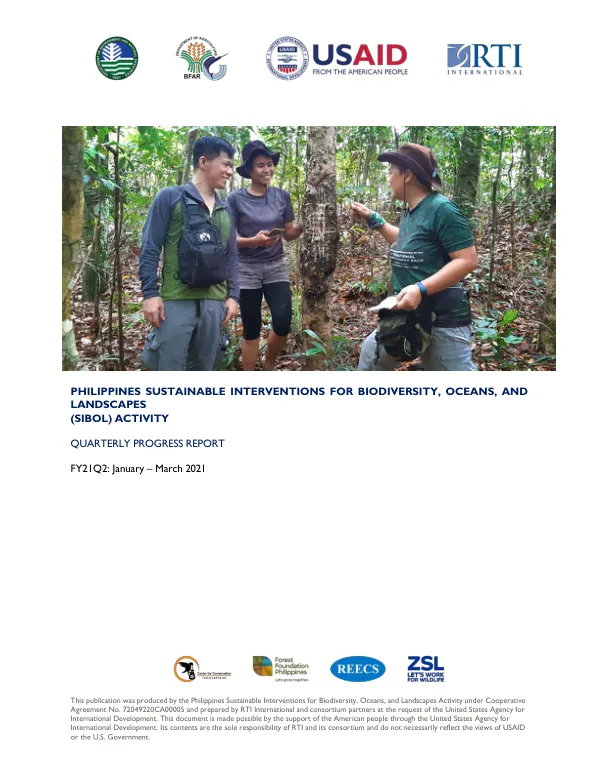
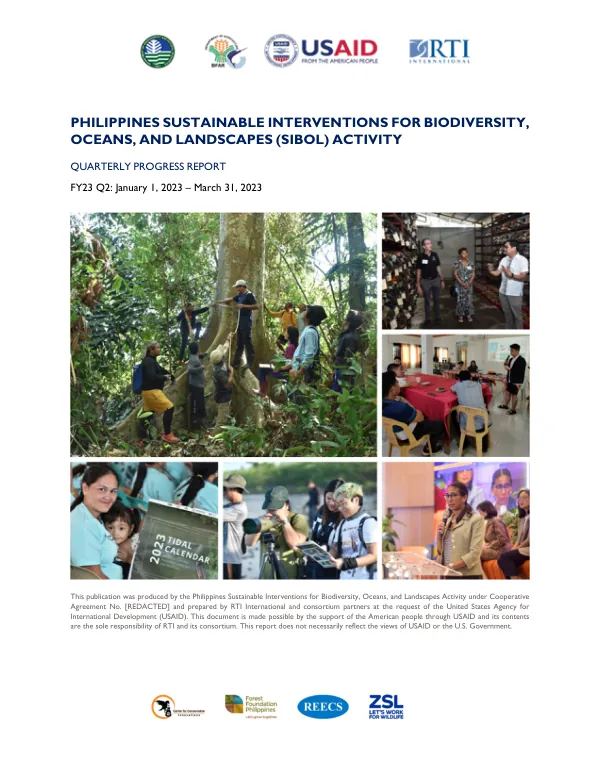
Philippines Sustainable Interventions for Biodiversity, Oceans, and Landscapes (SIBOL) Activity Quarterly Progress Report FY23 Q2
Sign inRTI INTERNATIONAL
Philippines Sustainable Interventions for Biodiversity, Oceans, and Landscapes (SIBOL) Activity Quarterly Progress Report FY23 Q2
The Philippines Sustainable Interventions for Biodiversity, Oceans, and Landscapes (SIBOL) Activity is a USAID-funded project aimed at promoting sustainable management of natural resources in the Philippines.
2023 · 72 pages
Sign in to readA free account is required to download.
Abstract
The project focuses on three strategic approaches: strengthening science-driven decision making, improving economic incentives, and strengthening enforcement. Strengthening science-driven decision making is a key component of the SIBOL Activity. This approach involves improving access to and use of lands, water, marine, and coastal areas and other natural resources. The project has made significant progress in this area, with the development of the Expanded Biodiversity Assessment and Monitoring System (eBAMS) and the Environmental Law Enforcement and Protection Service (ELEPS). These tools have been used to improve the effectiveness of conservation area management and empower stakeholders to participate in natural resource governance. The SIBOL Activity has also made significant progress in improving economic incentives for sustainable natural resource management. This approach involves private sector engagement in natural resource management, natural resource valuation, and the establishment of sustainable supply chains and ecosystem service markets. The project has established partnerships with private sector companies to promote sustainable practices and has developed tools such as the Socio-Economic Assessment and Monitoring System (SEAMS) to value ecosystem services. In addition to these strategic approaches, the SIBOL Activity has also made progress in strengthening enforcement of environmental laws and regulations. This approach involves building national enforcement capacities, promoting positive environmental behaviors, and using technologies to support enforcement efforts. The project has worked with government agencies to develop and implement policies and regulations that support sustainable natural resource management. The SIBOL Activity has also made significant progress in implementing its crosscutting strategies, which include improving natural resources policy framework, inter-agency collaboration and coordination, capacity building and training, and social and environmental safeguards. The project has worked with government agencies and civil society organizations to develop and implement policies and programs that support sustainable natural resource management. The SIBOL Activity has also made progress in implementing its site-specific outcomes and outputs, which include the establishment of marine protected areas, the promotion of sustainable forest management, and the development of ecosystem-based adaptation and resilience plans. The project has worked with local government units and civil society organizations to implement these activities and has made significant progress in promoting sustainable natural resource management at the local level. The SIBOL Activity has also made significant progress in implementing its sustainability, gender, and environmental risk mitigation activities. The project has worked with government agencies and civil society organizations to develop and implement policies and programs that support sustainable natural resource management and promote gender equality and social inclusion. The SIBOL Activity has also made significant progress in managing and administering its project. The project has established a strong management and operations system, which includes a performance indicator tracking table (PITT) and a theory of change diagram. The project has also made significant progress in managing its finances, with a total expenditure of $[REDACTED] as of the end of the second quarter of FY23. Overall, the SIBOL Activity has made significant progress in promoting sustainable natural resource management in the Philippines. The project has worked with government agencies, civil society organizations, and private sector companies to develop and implement policies and programs that support sustainable natural resource management and promote economic growth and poverty reduction.