USAID
PIRS Indicator 11.2: Probability of arrest
Probability of arrest is a performance indicator that measures the likelihood of an arrest will be made for a given suspected wildlife (or associated) crime.
2017 · 7 pages
Sign in to readA free account is required to download.
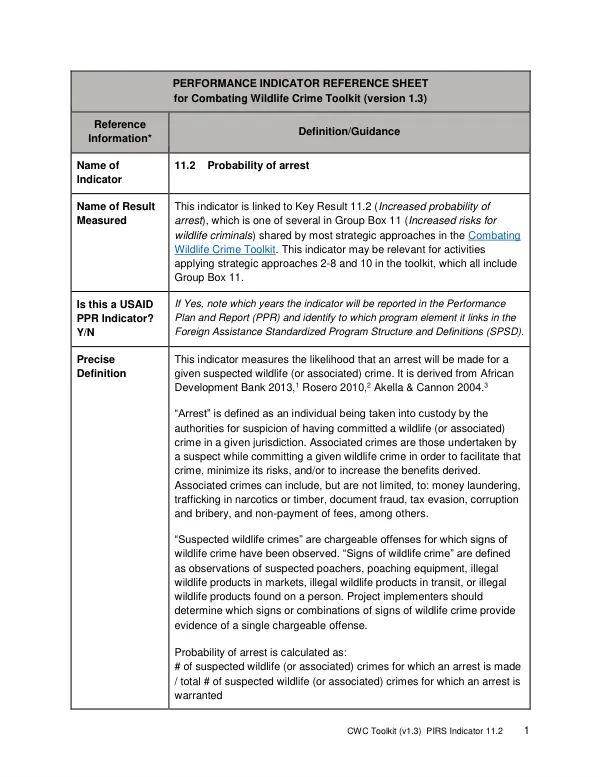
Abstract
This indicator is linked to Key Result 11.2, which is one of several in Group Box 11 of the Combating Wildlife Crime Toolkit. The indicator is relevant for activities applying strategic approaches 2-8 and 10 in the toolkit, which all include Group Box 11. The probability of arrest is derived from African Development Fund 2013, Hostero 2010, and Akella & Cannon 2004. Arrest is defined as an individual being taken into custody by authorities for suspected wildlife (or associated) crime in a given jurisdiction. Associated crimes include, but are not limited to, money laundering, trafficking in narcotics or timber, document forgery, tax evasion, corruption, bribery, and non-payment of fees. The probability of arrest is calculated as the number of suspected wildlife (or associated) crimes for which an arrest is made, divided by the total number of suspected wildlife (or associated) crimes for which an arrest is warranted. Higher values indicate a better outcome, assuming a fair and just system where those who are innocent are found innocent. This indicator measures the likelihood that an arrest will be made for a given suspected wildlife (or associated) crime. It may also be relevant for the associated result appears in a customized chain. For potential Group Box 11 "increased risk" key result indicators, project/monitoring design teams should advocate for a "do no harm" principle by being aware of creating perverse incentives through their choice of indicator. The probability of arrest should reflect the likelihood that a given suspected wildlife crime resulted in arrest. If it is not possible to track single cases, implementers should refer to the "Data Sources" section for guidance. This indicator should be measured in conjunction with other factors that are associated with increased risks for wildlife criminals, including the rate of detection, probability of prosecution, probability of conviction, and probability of appropriate penalty/deterrent applied to conviction. The probability of arrest is a probability indicator, with a unit of measure of probability. It is a dis-aggregated indicator, with specific charges (e.g., poaching, smuggling, purchasing illegal products, money laundering, etc.), the suspect's level (i.e., low-level, middleman, high-level/kingpin), and other useful disaggregates. The data source for this indicator is official records held by relevant authorities within given jurisdictions. The data are derived from a review of records held by relevant authorities within given jurisdictions. The design of data collection instruments, protocols for data collection and analysis should be informed by statistical methodologies and best practices in the field. Implementers should respect data ownership rights and sensitivity issues. All data should be archived and made available through the Development Data Library (DDL) per ADS Chapter 579, USAID Development Data.