CUSO INTERNATIONAL
Plan de Formation Continue de SOPECOD
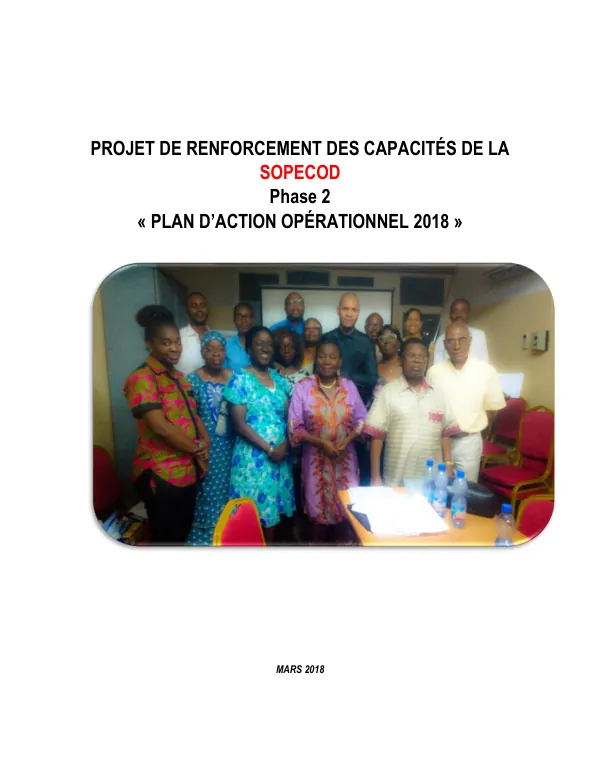
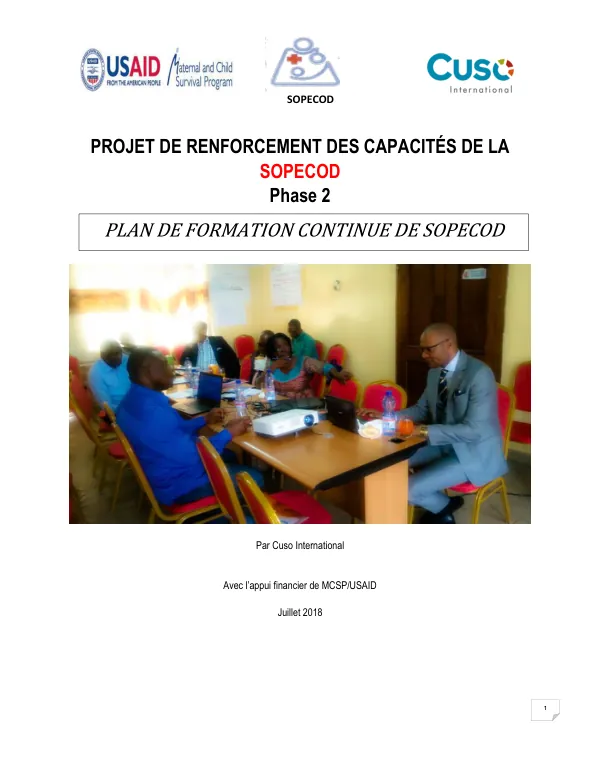
The Maternal and Child Survival Program (MCSP) of the United States Agency for International Development (USAID) has provided financial support for the SOPECOD capacity reinforcement project in the Democratic Republic of Congo.
2018 · 15 pages
Sign in to readA free account is required to download.
Abstract
The project, led by Cuso International, aims to improve the health of mothers, newborns, and children in the country. According to the National Health Development Plan (PNDS) 2016-2020, the health situation in the Democratic Republic of Congo is marked by high mortality rates for preventable causes. The data indicates that there are 846 maternal deaths per 100,000 live births, 28 neonatal deaths per 1,000 live births, 58 infant deaths per 1,000 live births, and 104 child and adolescent deaths per 1,000 live births. The country's large population, with 61% of people under the age of 20, and 52% under the age of 15, exacerbates the situation. The Inter-agency Group of Mortality Estimates (IGME) has reported that the mortality rates vary by urban and rural areas, with 32.5% of deaths occurring in urban areas and 47.1% in rural areas. The mortality rates also differ by sex, with 45.2% of deaths occurring among males and 40.2% among females. Additionally, the mortality rates vary by socioeconomic status, with 49.7% of deaths occurring among the poorest and 22.9% among the richest. To address this situation, the SOPECOD project aims to develop the knowledge and skills of healthcare personnel through a structured training program. The project's objective is to contribute to the improvement of neonatal, infant, and child health in the Democratic Republic of Congo by increasing the competence and performance of healthcare practitioners in the field of pediatric care. The project's specific objectives include evaluating the needs of trainees, adapting the training modules based on the data from SOPECOD, animating the training sessions, and inculcating a culture of follow-up and evaluation among trainees. The project also aims to provide tutoring, coaching, and mentoring between pediatricians and other healthcare practitioners working in the field of pediatrics. The project's impact is expected to be a significant reduction in neonatal and infant mortality rates across the Democratic Republic of Congo, achieved through the implementation of good practices and quality care in pediatrics. The project's target group includes pediatricians and other healthcare practitioners working in various sectors related to pediatrics. The project's approach is based on interaction, collaboration, and a Congolese perspective, with a focus on the realities of pediatric care in the country. The project also incorporates research-action, with theoretical concepts illustrated and accompanied by field experiences on pediatric care techniques and practices in the Democratic Republic of Congo. The project's plan of formation includes six thematic areas, each with specific modules of training. The thematic areas include diseases of the hands, tuberculosis and other respiratory infections in children, early and community-based detection of cardiovascular diseases in children, malnutrition, overweight, and obesity in children and adolescents, prevention, detection, and treatment of HIV and other viral diseases in children, and prevention and treatment of immediate causes of death in newborns. Each thematic area has a specific plan of formation, including the title of the training, the objective of the training, the knowledge and skills to be acquired, the target public, the responsible and animator, the cost, and the level of priority. The project's plan of formation is expected to be implemented over a period of four years, with a focus on the most critical areas of pediatric care in the Democratic Republic of Congo.
Related documents