U.S. NATIONAL RENEWABLE ENERGY LABORATORY
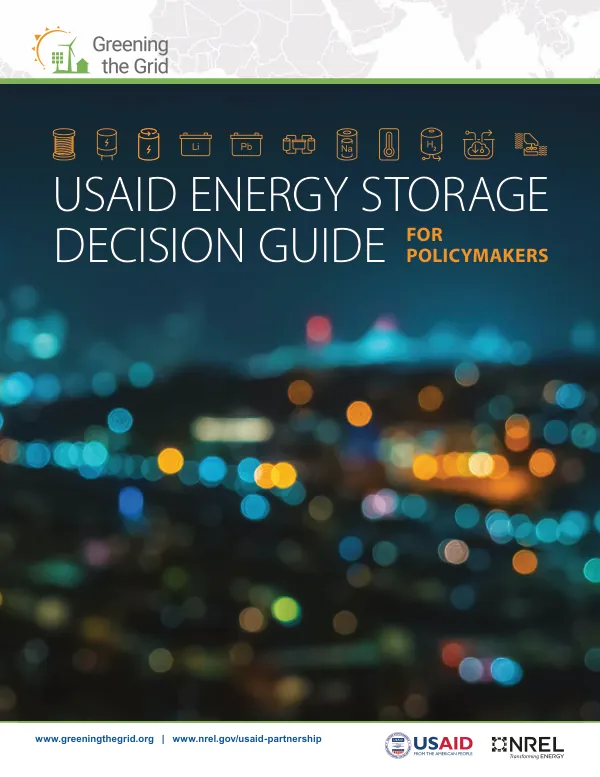
USAID Energy Storage Decision Guide for Policymakers
Energy storage is poised to become a major component of power systems of the future.
2021 · 57 pages
Sign in to readA free account is required to download.
Abstract
Energy storage has been instrumental for the development of affordable and reliable electricity supply since nearly the inception of modern power systems. More recently, technology advancements and rapidly falling costs for newer technologies, particularly battery energy storage systems, have ignited interest among utilities, policymakers, and end-use electricity customers across the world about opportunities for grid-connected energy storage to provide cost-effective grid services and enable increased deployment of variable renewable energy (VRE) resources. The purpose of this report is to arm relevant decision makers with the initial layer of information they need to understand energy storage and to make informed policy, regulatory, and investment decisions around grid-connected energy storage. While many of the case studies presented in this report are based on experiences from the U.S. and Europe, the lessons learned can be applied to power sectors in emerging economies. Importantly, this report covers topics related to grid-connected energy storage for power sector applications. Energy storage is part of a broader portfolio of grid solutions. Energy storage is one group of technologies in a broader toolbox of options to support the flexibility, reliability, and resilience of power systems. While it is a promising technology, it may not be appropriate or cost-effective for all circumstances. Thus, when considering a decision to invest in energy storage, it is essential to consider it in the context of the technical and economic merit of a wide array of options. Taking such a holistic view can lead to a least-cost and no-regrets portfolio of grid solutions. Energy storage can play a diversity of valuable roles in the power system. Energy storage can provide a range of power system flexibility and reliability services for the power system over different timescales relevant to the system. The same storage project can often provide multiple services to the grid. This multi-use approach to asset utilization is known as "value stacking." Various energy storage technologies are available, including pumped hydropower, lithium-ion batteries, flow batteries, and power-to-gas. Lithium-ion batteries have reached maturity and are experiencing significant deployment for shorter duration applications, while other emerging technologies are in earlier phases of development and commercialization. The cost of lithium-ion battery packs has dropped by 89% in the last decade, driven by a combination of R&D efforts and increased manufacturing capacity for the electric vehicle sector. This trend is projected to continue well into the next decade. Between 2018 and 2040, energy storage installations are projected to grow over 100 times. Energy storage is poised to become a major component of power systems of the future, providing cost-effective grid services and enabling increased deployment of variable renewable energy resources.